TERRY HANCOCK’S PINWHEEL GALAXY

The Southern Pinwheel Galaxy M83  
This collaboration by Retired Airforce Col. John Mansur of Florida who acquired the LRGB data remotely from Siding Spring NSW Australia using a 500mm Planewave/FLI-PLO9000 with processing by Terry Hancock using CCDStack and CS5 

Total Integration Time 140 minutes

TERRY HANCOCK


CLIMATE : “ADJUSTING” THE DATA ON CLIMATE

NOAA/NCDC’s new ‘pause-buster’ paper: a laughable attempt to create warming by adjusting past data

Did SNL’s Tommy Flanagan Oversee the New Surface Temperature Data?

By Bob Tisdale and Anthony Watts, commentary from Dr. Judith Curry follows

There is a new paper published the journal Science about the recent slowdown in global surface warming (released from embargo today at 2PM eastern).  It is from Tom Karl and others at NOAA’s newly formed NCEI, National Centers for Environmental Information (a merger of three NOAA data centers: NCDC, NODC and NGDC) and from the government-consulting firm LMI.  The lead author is Tom Karl, Director of NCEI and Chair of the Subcommittee on Global Change Research (SGCR) of the U.S. Global Change Research Program (USGCRP).  The paper is Karl et al (2015) Possible artifacts of data biases in the recent global surface warming hiatus.  “Possible” is obviously the key word in the title.

There is a big push by the American Association for the advancement of Science (AAAS) to promote this paper. Here is what they sent out to press contacts days in advance:

Science Press Package

This information is embargoed until:

2:00 PM U.S. Eastern Time, Thursday, 4 June 2015
Check timezone conversions here.

Please cite the journal Science and the publisher, AAAS, the science society, as the source of this information. Please hyperlink to www.sciencemag.org when publishing online.


Summaries of Articles in the 5 June Science

Evidence Against a Global Warming Hiatus?
An analysis using updated global surface temperature data disputes the existence of a 21st century global warming slowdown described in studies including the latest Intergovernmental Panel on Climate Change (IPCC) assessment. The new analysis suggests no discernable decrease in the rate of warming between the second half of the 20th century, a period marked by manmade warming, and the first fifteen years of the 21st century, a period dubbed a global warming “hiatus.” Numerous studies have been done to explain the possible causes of the apparent hiatus. Here, Karl and colleagues focused on aspects of the hiatus influenced by biases from temperature observation networks, which are always changing. Using updated and corrected temperature observations taken at thousands of weather observing stations over land and as many commercial ships and buoys at sea, the researchers show that temperatures in the 21st century did not plateau, as thought. Instead, the rate of warming during the first fifteen years of the 21st century is at least as great as that in the last half of the 20th century, suggesting warming is continuing apace. According to these and other results, the authors suggest the warming slowdown was an illusion, an artifact of earlier analyses.

Article #16: “Possible artifacts of data biases in the recent global surface warming hiatus,” by T.R. Karl; A. Arguez; B. Huang; J.H. Lawrimore; M.J. Menne; T.C. Peterson; R.S. Vose; H.-M. Zhang at National Oceanographic and Atmospheric Administration (NOAA) in Asheville, NC; J.R. McMahon at LMI in McLean, VA.

ADVERTISEMENT

The abstract of Karl et al (2015) reads (our boldface):

Much study has been devoted to the possible causes of an apparent decrease in the upward trend of global surface temperatures since 1998, a phenomenon that has been dubbed the global warming “hiatus.” Here we present an updated global surface temperature analysis that reveals that global trends are higher than reported by the IPCC, especially in recent decades, and that the central estimate for the rate of warming during the first 15 years of the 21st century is at least as great as the last half of the 20th century. These results do not support the notion of a “slowdown” in the increase of global surface temperature.

Karl et al expand on that highlighted discussion in the text of the paper (our boldface):

It is also noteworthy that the new global trends are statistically significant and positive at the 0.10 significance level for 1998–2012 (Fig. 1 and table S1) using the approach described in (25) for determining trend uncertainty. In contrast, IPCC (1), which also utilized the approach in (25), re-ported no statistically significant trends for 1998-2012 in any of the three primary global surface temperature datasets. Moreover, for 1998–2014, our new global trend is 0.106± 0.058°C dec−1, and for 2000–2014 it is 0.116± 0.067°C dec−1 (see table S1 for details). This is similar to the warming of the last half of the 20th century (Fig. 1). A more comprehensive approach for determining the 0.10 significance level (see supplement) that also accounts for the impact of annual errors of estimate on the trend, also shows that the 1998–2014 and 2000–2014 trends (but not 1998–2012) were positive at the 0.10 significance level.

THE MISDIRECTION

As shown in their Figure 1 (also our Figure 1), Karl et al. (2015) used the periods of 1951 to 2012 and 1950 to 1999 as references for the recent slowdown in surface warming.  The IPCC’s 5th Assessment Report serves as the justification for the early-1950s start point for their reference periods. See Chapter 2 and Chapter 9 of AR5 for the IPCC’s brief mention of the slowdown in global surface warming.

Figure 1

Figure 1

Yet the climate model-based projections of a disaster-filled future global surface warming better align with the warming rate of the recent warming period, which began in the mid-1970s, not 1950. See Figure 2, which uses the GISS Land-Ocean Temperature Index data, because the new NCDC data have not yet been released. Keep in mind there was an earlier hiatus that lasted from the early-to-mid 1940s to the mid-1970s.

Figure 2

Figure 2

If NOAA would like to revise their estimates of future global warming to reflect the more benign warming rate of 0.1 deg C/decade from 1950 to 1999, it would be a big step toward their coming to terms with reality.

We illustrate the ever-growing differences between models and data in the monthly global surface temperature (and lower troposphere temperature) update posts.  Figure 3 is the model-data comparison from the April 2015 update.

Figure 3

Figure 3

NEW DATA USED

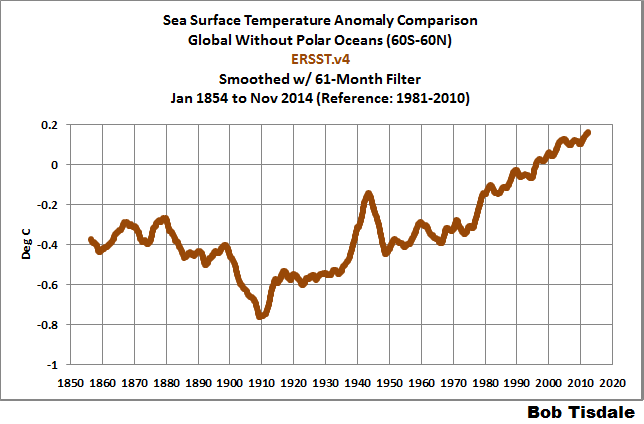
In many respects, the paper is an introduction to a revised global surface temperature dataset from NOAA. For the oceans, it includes their new ERSST.v4 sea surface temperature data.  We discussed that new NOAA sea surface temperature data in the post Has NOAA Once Again Tried to Adjust Data to Match Climate Models? (The WattsUpWithThat cross post is here.)

For the land portion, Karl et al. (2015) state:

Third, there have also been advancements in the calculation of land surface air temperatures (LSTs). The most important is the release of the International Surface Temperature Initiative (ISTI) databank (1419), which forms the basis of the LST component of our new analysis. The ISTI databank integrates the Global Historical Climatology Network (GHCN)–Daily dataset (20) with over 40 other historical data sources, more than doubling the number of stations available.

ADJUSTMENTS MAKE MOST OF THE WARMING

NCDC has been in the business of adjusting the surface temperature record for quite some time. The modus operandi so far has been to get a new paper published describing what NCDC considers to be a new and improved dataset, and since NCDC’s articles are often peer reviewed by other government employed scientists at NOAA, they often don’t get a critical peer review. Certainly, based on the reports I’ve received over the years, few if any skeptic scientists have ever been asked to review an NCDC paper on a new global temperature dataset and the techniques involved.

Fortunately, it is very easy to divine such adjustments by comparing the raw data and the final adjusted data, as shown in the graph below. Note how the past gets cooler, centered around 1915 and the present gets warmer.


NCDC%20MaturityDiagramSince20080517[1]

Figure 4 Maturity diagram showing net change since 17 May 2008 in the global monthly surface air temperature record prepared by the National Climatic Data Center (NCDC), USA. The net result of the adjustments made are becoming substantial, and adjustments since May 2006 occasionally exceeds 0.1oC. Before 1945 global temperatures are generally changed toward lower values, and toward higher values after 1945, resulting in a more pronounced 20th century warming (about 0.15oC) compared to the NCDC temperature record published in May 2008. Arrows indicate two months where the adjustments over time are illustrated in the figure below. Last diagram update: 19 May 2015. Source: Professor Ole Humlum

Figure 4 

On May 2, 2011, NCDC transitioned to GHCN-M version 3 as the official land component of its global temperature monitoring efforts.  In November 2011, the GHCN-M version 3.1.0 replaced the GHCN-M version 3. The overall net effect of the transition from GHCN-M version 2 to version 3 is to increase global temperatures before 1900, to decrease them between 1900 and 1950, and to increase temperatures after 1950.

The diagram below exemplify adjustments made by NCDC since May 2008 for two single months (see arrows in diagram above); January 1915 and January 2000.


NCDC%20Jan1915%20and%20Jan2000[1]

Figure 5 Diagram showing the adjustment made since May 2008 by the National Climatic Data Center (NCDC) in the anomaly values for the two months January 1915 and January 2000. Last diagram update 19 May 2015. Source: Professor Ole Humlum

Figure 5 

Clearly, with each revision of data, NCDC is making the past cooler and the near present warmer through their adjustment process of the original data. To revisit something said in regards to a previous news story about NCDC’s tendency to adjust data as time goes on, so much so that they can’t even tell us with certainty anymore which month in the past century was the warmest on record, this is still applicable:

“Is history malleable? Can temperature data of the past be molded to fit a purpose? It certainly seems to be the case here, where the temperature for July 1936 reported … changes with the moment,” Watts told FoxNews.com.

“In the business and trading world, people go to jail for such manipulations of data.”

Hold that thought, because NCDC is at it again.

THE IMPACT OF NOAA’S SHIP-BUOY BIAS ADJUSTMENTS DURING THE SLOWDOWN HAVE MADE THEIR NEW SEA SURFACE TEMPERATURE DATASET AN OUTLIER

You’ll note in Figure 1 that the biggest changes between the new and old NOAA data during the global-warming-slowdown periods are in the sea surface temperature data, not the land surface air temperature data.  Those adjustments are supposed to be justified by ship-buoy biases. See the quotes in the post Quick Look at the DATA for the New NOAA Sea Surface Temperature Dataset, under the heading of SHIP-BUOY BIAS CORRECTIONS IN ERSST.v4.

(Note 1: the buoys being discussed are NOT ARGO floats.  The buoys used for sea surface temperature measurements are Surface Drifting Buoys and fixed buoys like the TAO Project buoys. Note 2: the latitudes of 60S-60N were used for the following graphs to avoid any differences in how sea ice is accounted for between the datasets and to be consistent with the two papers that introduced the new ERSST.v4 data.  Note 3:  the trends shown are for sea surface temperatures.  They are not directly comparable to the trends discussed by Karl et al. in the second quote, which were for combined land-plus-ocean data.)

THE UKMO HASST3 data have also been adjusted for ship-buoy biases. For the two slowdown periods presented by Karl et al., Figures 6 and 7 compare the HADSST3 and the new NOAA ERSST.v4 data, both of which have been “corrected” for ship-buoys biases, to the older NOAA ERSST.v3b which had not been adjusted for those biases. During both periods, the bias-adjusted HADSST3 data have a much lower trend than the bias-adjusted NOAA ERSST.v4 data.  In fact, the bias-corrected HADSST3 data in both cases is more in line with the older NOAA data than the new.

Figure 4

Figure 6

Figure 5

Figure 7

Some might think that NOAA under the direction of Tom Karl designed their ship-buoy bias adjustments with the sole intent of minimizing the impacts of natural slowdown in surface warming.  (Those would be some interesting emails and meeting minutes to read.)

And just in case you’re wondering, the new NOAA ERSST.v4 data are compared to the NOAA and UKMO satellite-enhanced sea surface temperature data in Figures 8 and 9.

Figure 6

Figure 8

Figure 7

Figure 9

As noted in the heading, with their new adjustments, NOAA has created an outlier in their new sea surface temperature dataset.  Add that to the curious spike in the late-1930s and1940s that can’t be explained by climate models, which were presented in the post here.

BUT THE WARMING RATES OF NOAA’S OLD AND NEW SEA SURFACE TEMPERATURE DATA ARE THE SAME OVER THE PAST 3+ DECADES

The satellite era of sea surface temperature data started in November 1981.  Neither of the NOAA sea surface temperature reconstructions (new or old) utilize the satellite-enhanced data. The original version of the NOAA ERSST.v3 data included satellite data when they were first released in 2008, but the satellite data were removed before the dataset became “official” because they did not meet political agenda of the dataset users, which were only NOAA at that time.  The revised dataset was renamed ERSST.v3b.  It is ERSST.v3b that Karl et al. are calling the “old” data.

But we can learn something very interesting if we compare NOAA’s ERSST.v4 (new) and ERSST.v3b (old) data during the satellite era. See Figure 10.

Figure 8

Figure 10

The warming rates are the same.

But the new data show a much higher warming rate during the “hiatus” periods, and that means…

TO MANUFACTURE WARMING DURING THE HIATUS, NOAA ADJUSTED THE PRE-HIATUS DATA DOWNWARD 

If we subtract the ERSST.v3b (old) data from the new ERSST.v4 data, Figure 11, we can see that that is exactly what NOAA did.

Figure 9

Figure 11

Remember the adjusted data from figures 4 and 5 above? Figure 11 uses the same data subtraction method to determine the difference between the original measured data, and the “new and improved”adjusted data courtesy of government-funded science. It’s the same story all over again; the adjustments go towards cooling the past and thus increasing the slope of temperature rise.

Their intent and methods are so obvious they’re laughable.

It’s like John Lovitz Saturday Night Live character “Pathological liar”, Tommy Flanagan was in charge.

Gee, we need to show more sea surface warming during the hiatus, but we don’t want to increase the trend since about 1982.  

Featured ImageIt’s hard to imagine how anyone could take the new NOAA global surface temperature data seriously.

SEA SURFACE TEMPERATURE DATA SOURCE

The sea surface temperature data presented in this post are available from the KNMI Climate Explorer.


Comments from Georgia Tech Climatologist Dr. Judith Curry:

The greatest changes in the new NOAA surface temperature analysis is to the ocean temperatures since 1998.  This seems rather ironic, since this is the period where there is the greatest coverage of data with the highest quality of measurements – ARGO buoys and satellites don’t show a warming trend.  Nevertheless, the NOAA team finds a substantial increase in the ocean surface temperature anomaly trend since 1998.

In my opinion, the gold standard dataset for global ocean surface temperatures is the UK dataset, HadSST3.  A review of the uncertainties is given in this paper by John Kennedy http://www.metoffice.gov.uk/hadobs/hadsst3/uncertainty.html.  Note, the UK group has dealt with the same issues raised by the NOAA team.  I personally see no reason to the use the NOAA ERSST dataset, I do not see any evidence that the NOAA group has done anywhere near as careful a job as the UK group in processing the ocean temperatures.

I am also unconvinced by NOAA’s gap filling in the Arctic, and in my opinion this introduces substantial error into their analysis.  I addressed the issue of gap filling in the Arctic in this recent publication:  Curry JA, 2014:  Climate science:  Uncertain temperature trends. Nature Geoscience, 7, 83-84.

Relevant text:

Gap filling in the Arctic is complicated by the presence of land, open water and temporally varying sea ice extent, because each surface type has a distinctly different amplitude and phasing of the annual cycle of surface temperature. Notably, the surface temperature of sea ice remains flat during the sea ice melt period roughly between June and September, whereas land surface warming peaks around July 1. Hence using land temperatures to infer ocean or sea ice temperatures can incur significant biases.

With regards to uncertainty, in their ‘warmest year’ announcement last January, NOAA cited an error margin in the global average surface temperature anomaly of 0.09oC. The adjustments to the global average surface temperature anomaly is within the error margin, but the large magnitude of the adjustments further support a larger error margin.  But they now cite a substantially greater trend for the period 1998-2014, that is now statistically greater than zero at the 90% confidence level.

My bottom line assessment is this.  I think that uncertainties in global surface temperature anomalies is substantially understated.  The surface temperature data sets that I have confidence in are the UK group and also Berkeley Earth.  This short paper in Science is not adequate to explain and explore the very large changes that have been made to the NOAA data set.   The global surface temperature datasets are clearly a moving target.  So while I’m sure this latest analysis from NOAA will be regarded as politically useful for the Obama administration, I don’t regard it as a particularly useful contribution to our scientific understanding of what is going on.


POPE CALLS FOR ON GLOBAL WARMING

(POPE IS RIGHT AGAIN: LIKE HE IS RIGHT THAT JESUS IS SON OF GOD, IT IS OK TO ASSAULT AND RAPE THE BOYS IN CHOIR, IT IS OK FOR SERBS TO KILL MUSLIMS ETC.)


Pope Calls Global Warming a Threat And Urges Action

Draft of encyclical calls reducing carbon emissions an ‘urgent’ matter

Pope Francis attended an event in St. Peter’s Square at the Vatican on Sunday. In a paper, he calls for policies that reduce carbon emissions.ENLARGE
Pope Francis attended an event in St. Peter’s Square at the Vatican on Sunday. In a paper, he calls for policies that reduce carbon emissions. PHOTO: GIAMPIERO SPOSITO/REUTERS
By

FRANCIS X. ROCCA

Updated June 15, 2015 7:05 p.m. ET

ROME—Pope Francis calls global warming a major threat to life on the planet, says it is due mainly to human activity, and describes the need to reduce the use of fossil fuels as an urgent matter, in a published draft of a much-awaited upcoming letter on the environment.

The draft copy of “Laudato Si’ ” (“Be praised”), his encyclical on the environment, has been eagerly awaited by business, policy makers and environmental groups. It was published online on Monday by the Italian magazine L’Espresso, three days ahead of its scheduled publication date.

The Vatican said the posted text wasn’t the final document, which would remain under embargo until Thursday, but it didn’t say whether there were material differences between the draft and the final document.

An encyclical is widely considered one of the highest forms of papal writing, intended to explain and elaborate Catholic teaching.

“Laudato Si’ ” is addressed not only to Catholics but to “every person who lives on this planet,” the pope wrote. In it, the pontiff related ecological concerns to his signature theme of economic justice, especially the gap in wealth between the global north and south.

In the draft, the pope wades into the debate over climate change, writing of a “very consistent scientific consensus that we are in the presence of an alarming warming of the climactic system.”

He writes that there is an “urgent and compelling” need for policies that reduce carbon emissions, among other ways, by “replacing fossil fuels and developing sources of renewable energy.”

While acknowledging that natural causes, including volcanic activity, play a role in climate change, the pope writes that “numerous scientific studies indicate that the greater part of global warming in recent decades is due to the great concentration of greenhouse gases (carbon dioxide, methane, nitrogen oxide and others) emitted above all due to human activity.”

The encyclical has acquired outsized importance in recent months, given the moral suasion and the popularity of Argentina-born Pope Francis, the first pontiff from the developing world and one who has been particularly vocal in his advocacy of the poor and criticism of big business. Moreover, the encyclical comes at a time when governments, investors, industry executives and environmentalists are debating policy measures to address climate change.

Pope Francis after a mass in Tacloban in the Philippines in January.ENLARGE
Pope Francis after a mass in Tacloban in the Philippines in January. PHOTO: JOHANNES EISELE/AGENCE FRANCE-PRESSE/GETTY IMAGES

The pope’s letter brings a new dimension to the wrangling over the issue. In 2013, a landmark United Nations report concluded that there was a 95% level of certainty that humans are responsible for most global warming and reiterated that a long-term planetary warming trend was expected to continue. The report said that air and oceans are getting warmer, ice and snow are less plentiful, and sea levels are rising. The U.N. report is believed to broadly reflect the views of most climate scientists.

Some other researchers, though, have remained skeptical about global warming and they remain unconvinced that human activity is the dominant cause.

Paul C. Knappenberger, a climate scientist with Cato Institute, a Libertarian think tank, said the pope “goes too far in the perception that the changing of the climate leads to bad outcomes and necessarily needs some sort of immediate reaction.”

Crucially, the pontiff’s words are expected to bolster the case of scientists and politicians who are seeking a global pact aimed at reducing greenhouse-gas emissions and potentially avoiding significant additional warming of the earth’s atmosphere and oceans.

The pope “is going to be reaching people that haven’t thought about this,” said Mindy Lubber, president of Ceres, a Boston-based nonprofit group that works with more than 100 companies with investments totaling $13 trillion to address climate risks to their business.

In December, nearly 200 countries are expected to meet in Paris and sign the new climate change agreement. Earlier this year, Pope Francis—who expressed disappointment at the failure of past international efforts to reach agreement on the issue—said that he aimed to publish the encyclical in time to affect the Paris meeting.

Sen. Edward Markey (D.-Mass.), one of Washington’s most vocal proponents of aggressive action on climate change, said the Pope’s encyclical “comes at a critical time as the world’s nations prepare to convene for international climate negotiations in Paris in December.”

The pope’s encyclical also comes as oil companies are turning increasingly vocal on climate change amid rising scrutiny from investors and governments. Many are looking to influence the debate by proposing remedies, including the imposition of a carbon tax, that might have a lesser impact on their business than more wide-ranging changes being sought by some.

Many of the industries’ largest players are advocating a shift away from coal to cleaner-burning gas—which they are producing in ever larger volumes—as a means to mitigate climate change while continuing to meet rising energy demand in the coming decades.

Earlier this year, Exxon Mobil Corp. sent a senior lobbyist to Rome in an attempt to brief the Vatican on its outlook for energy markets.

The American Petroleum Institute, a national trade organization that represents the U.S. oil and gas industry, including Exxon, said it was working to review the leaked document.

In laying out his thesis, the pope returned to his frequent criticisms of business, the problems of income inequality and the plight of poor countries.

The pope wrote that powerful economic and political interests seek to “mask the problems or hide the symptoms, seeking only to reduce the negative impacts of climate change.” But he warned that global warming could worsen “if we continue with the current models of production and consumption.”

Pope Francis also highlighted other environmental problems, including the depletion of clean water due to overconsumption and the loss of biodiversity.

“Water poverty” is especially acute in Africa and other poor regions, where poor water quality foments disease and shortages lead to rising food prices, the pope wrote.

Pope Francis emphasized the unequal social effects of environmental problems, which he said “strike in a special way the weakest on the planet.” Unequal access to natural resources has led to an “ecological deficit” between the northern and southern hemispheres, with the former exploiting the latter to the enrichment of its industrial economy, he wrote.

The 191-page document includes extensive sections on Catholic theology of creation, as well as critiques of economic globalization and consumer culture, which the pope argues have led to environmental degradation.

In terms of practical solutions, the Pope recognizes that poorer countries, which are typically dependent on fossil fuels, must put a priority on the “eradication of misery and the social development of their inhabitants.” In their transition to less polluting energy sources, such countries must count on the assistance of already developed countries, through subsidies and technology transfers, he writes.

The pope rejected population control as a solution to such inequities. “To blame demographic growth and not the extreme and selective consumption of some is a way of not facing the problem,” he wrote.

Part of the solution lies in adopting “another style of life,” featuring more environmentally conscious behavior, such as reducing use of paper, plastic and water; separating trash; car-sharing and turning off unnecessary lights, the pope wrote.

“One must not think that these efforts won’t change the world,” he wrote.

—Tammy Audiand Gautam Naik contributed to this article.


TERRY HANCOCK : ANOTHER MASTERPIECE

ANOTHER MASTERPIECE BY  TERRY HANCOCK  TS


terry

Page Liked · Yesterday · Edited·

The Crescent & Gamma Cygni NebulaeA very deep and Bi-Color view of The Crescent and Gamma Cygni Nebulae using H-Alpha and OIII filters covering 4.01 x 2.62 degrees of sky. 
Captured from my amateur backyard observatory in Fremont, Michigan using a QHY11 Monochrome CCD/Takahashi E-180.
Total Integration Time 3.3 hoursImage details
Location: DownUnder Observatory, Fremont MI
Date of Shoot: March 12th 2014, June 9th 2015 
H-Alpha 120 min, 15 x 10 min bin 1×1
OIII 80 min, 8 x 10 min 1×1 Equipment
QHY11S monochrome CCD cooled to -20C 
Takahashi E-180 F2.8 Astrograph
Paramount GT-1100S German Equatorial Mount
Image Acquisition Maxim DL
Stacking and Calibrating: CCDStack
Registration of images in Registar
Post Processing Photoshop CS5


DATA “ADJUSTMENT” FRAUD

NOAA/NCDC’s new ‘pause-buster’ paper: a laughable attempt to create warming by adjusting past data

Did SNL’s Tommy Flanagan Oversee the New Surface Temperature Data?

By Bob Tisdale and Anthony Watts, commentary from Dr. Judith Curry follows

There is a new paper published the journal Science about the recent slowdown in global surface warming (released from embargo today at 2PM eastern).  It is from Tom Karl and others at NOAA’s newly formed NCEI, National Centers for Environmental Information (a merger of three NOAA data centers: NCDC, NODC and NGDC) and from the government-consulting firm LMI.  The lead author is Tom Karl, Director of NCEI and Chair of the Subcommittee on Global Change Research (SGCR) of the U.S. Global Change Research Program (USGCRP).  The paper is Karl et al (2015) Possible artifacts of data biases in the recent global surface warming hiatus.  “Possible” is obviously the key word in the title.

There is a big push by the American Association for the advancement of Science (AAAS) to promote this paper. Here is what they sent out to press contacts days in advance:

Science Press Package

This information is embargoed until:

2:00 PM U.S. Eastern Time, Thursday, 4 June 2015
Check timezone conversions here.

Please cite the journal Science and the publisher, AAAS, the science society, as the source of this information. Please hyperlink to www.sciencemag.org when publishing online.

Summaries of Articles in the 5 June Science

Evidence Against a Global Warming Hiatus?
An analysis using updated global surface temperature data disputes the existence of a 21st century global warming slowdown described in studies including the latest Intergovernmental Panel on Climate Change (IPCC) assessment. The new analysis suggests no discernable decrease in the rate of warming between the second half of the 20th century, a period marked by manmade warming, and the first fifteen years of the 21st century, a period dubbed a global warming “hiatus.” Numerous studies have been done to explain the possible causes of the apparent hiatus. Here, Karl and colleagues focused on aspects of the hiatus influenced by biases from temperature observation networks, which are always changing. Using updated and corrected temperature observations taken at thousands of weather observing stations over land and as many commercial ships and buoys at sea, the researchers show that temperatures in the 21st century did not plateau, as thought. Instead, the rate of warming during the first fifteen years of the 21st century is at least as great as that in the last half of the 20th century, suggesting warming is continuing apace. According to these and other results, the authors suggest the warming slowdown was an illusion, an artifact of earlier analyses.

Article #16: “Possible artifacts of data biases in the recent global surface warming hiatus,” by T.R. Karl; A. Arguez; B. Huang; J.H. Lawrimore; M.J. Menne; T.C. Peterson; R.S. Vose; H.-M. Zhang at National Oceanographic and Atmospheric Administration (NOAA) in Asheville, NC; J.R. McMahon at LMI in McLean, VA.

The abstract of Karl et al (2015) reads (our boldface):

Much study has been devoted to the possible causes of an apparent decrease in the upward trend of global surface temperatures since 1998, a phenomenon that has been dubbed the global warming “hiatus.” Here we present an updated global surface temperature analysis that reveals that global trends are higher than reported by the IPCC, especially in recent decades, and that the central estimate for the rate of warming during the first 15 years of the 21st century is at least as great as the last half of the 20th century. These results do not support the notion of a “slowdown” in the increase of global surface temperature.

Karl et al expand on that highlighted discussion in the text of the paper (our boldface):

It is also noteworthy that the new global trends are statistically significant and positive at the 0.10 significance level for 1998–2012 (Fig. 1 and table S1) using the approach described in (25) for determining trend uncertainty. In contrast, IPCC (1), which also utilized the approach in (25), re-ported no statistically significant trends for 1998-2012 in any of the three primary global surface temperature datasets. Moreover, for 1998–2014, our new global trend is 0.106± 0.058°C dec−1, and for 2000–2014 it is 0.116± 0.067°C dec−1 (see table S1 for details). This is similar to the warming of the last half of the 20th century (Fig. 1). A more comprehensive approach for determining the 0.10 significance level (see supplement) that also accounts for the impact of annual errors of estimate on the trend, also shows that the 1998–2014 and 2000–2014 trends (but not 1998–2012) were positive at the 0.10 significance level.

THE MISDIRECTION

As shown in their Figure 1 (also our Figure 1), Karl et al. (2015) used the periods of 1951 to 2012 and 1950 to 1999 as references for the recent slowdown in surface warming.  The IPCC’s 5th Assessment Report serves as the justification for the early-1950s start point for their reference periods. See Chapter 2 and Chapter 9 of AR5 for the IPCC’s brief mention of the slowdown in global surface warming.

Figure 1

Figure 1

Yet the climate model-based projections of a disaster-filled future global surface warming better align with the warming rate of the recent warming period, which began in the mid-1970s, not 1950. See Figure 2, which uses the GISS Land-Ocean Temperature Index data, because the new NCDC data have not yet been released. Keep in mind there was an earlier hiatus that lasted from the early-to-mid 1940s to the mid-1970s.

Figure 2

Figure 2

If NOAA would like to revise their estimates of future global warming to reflect the more benign warming rate of 0.1 deg C/decade from 1950 to 1999, it would be a big step toward their coming to terms with reality.

We illustrate the ever-growing differences between models and data in the monthly global surface temperature (and lower troposphere temperature) update posts.  Figure 3 is the model-data comparison from the April 2015 update.

Figure 3

Figure 3

NEW DATA USED

In many respects, the paper is an introduction to a revised global surface temperature dataset from NOAA. For the oceans, it includes their new ERSST.v4 sea surface temperature data.  We discussed that new NOAA sea surface temperature data in the post Has NOAA Once Again Tried to Adjust Data to Match Climate Models? (The WattsUpWithThat cross post is here.)

For the land portion, Karl et al. (2015) state:

Third, there have also been advancements in the calculation of land surface air temperatures (LSTs). The most important is the release of the International Surface Temperature Initiative (ISTI) databank (1419), which forms the basis of the LST component of our new analysis. The ISTI databank integrates the Global Historical Climatology Network (GHCN)–Daily dataset (20) with over 40 other historical data sources, more than doubling the number of stations available.

ADJUSTMENTS MAKE MOST OF THE WARMING

NCDC has been in the business of adjusting the surface temperature record for quite some time. The modus operandi so far has been to get a new paper published describing what NCDC considers to be a new and improved dataset, and since NCDC’s articles are often peer reviewed by other government employed scientists at NOAA, they often don’t get a critical peer review. Certainly, based on the reports I’ve received over the years, few if any skeptic scientists have ever been asked to review an NCDC paper on a new global temperature dataset and the techniques involved.

Fortunately, it is very easy to divine such adjustments by comparing the raw data and the final adjusted data, as shown in the graph below. Note how the past gets cooler, centered around 1915 and the present gets warmer.


NCDC%20MaturityDiagramSince20080517[1]

Figure 4 Maturity diagram showing net change since 17 May 2008 in the global monthly surface air temperature record prepared by the National Climatic Data Center (NCDC), USA. The net result of the adjustments made are becoming substantial, and adjustments since May 2006 occasionally exceeds 0.1oC. Before 1945 global temperatures are generally changed toward lower values, and toward higher values after 1945, resulting in a more pronounced 20th century warming (about 0.15oC) compared to the NCDC temperature record published in May 2008. Arrows indicate two months where the adjustments over time are illustrated in the figure below. Last diagram update: 19 May 2015. Source: Professor Ole Humlum

Figure 4

On May 2, 2011, NCDC transitioned to GHCN-M version 3 as the official land component of its global temperature monitoring efforts.  In November 2011, the GHCN-M version 3.1.0 replaced the GHCN-M version 3. The overall net effect of the transition from GHCN-M version 2 to version 3 is to increase global temperatures before 1900, to decrease them between 1900 and 1950, and to increase temperatures after 1950.

The diagram below exemplify adjustments made by NCDC since May 2008 for two single months (see arrows in diagram above); January 1915 and January 2000.


NCDC%20Jan1915%20and%20Jan2000[1]

Figure 5 Diagram showing the adjustment made since May 2008 by the National Climatic Data Center (NCDC) in the anomaly values for the two months January 1915 and January 2000. Last diagram update 19 May 2015. Source: Professor Ole Humlum

Figure 5

Clearly, with each revision of data, NCDC is making the past cooler and the near present warmer through their adjustment process of the original data. To revisit something said in regards to a previous news story about NCDC’s tendency to adjust data as time goes on, so much so that they can’t even tell us with certainty anymore which month in the past century was the warmest on record, this is still applicable:

“Is history malleable? Can temperature data of the past be molded to fit a purpose? It certainly seems to be the case here, where the temperature for July 1936 reported … changes with the moment,” Watts told FoxNews.com.

“In the business and trading world, people go to jail for such manipulations of data.”

Hold that thought, because NCDC is at it again.

THE IMPACT OF NOAA’S SHIP-BUOY BIAS ADJUSTMENTS DURING THE SLOWDOWN HAVE MADE THEIR NEW SEA SURFACE TEMPERATURE DATASET AN OUTLIER

You’ll note in Figure 1 that the biggest changes between the new and old NOAA data during the global-warming-slowdown periods are in the sea surface temperature data, not the land surface air temperature data.  Those adjustments are supposed to be justified by ship-buoy biases. See the quotes in the post Quick Look at the DATA for the New NOAA Sea Surface Temperature Dataset, under the heading of SHIP-BUOY BIAS CORRECTIONS IN ERSST.v4.

(Note 1: the buoys being discussed are NOT ARGO floats.  The buoys used for sea surface temperature measurements are Surface Drifting Buoys and fixed buoys like the TAO Project buoys. Note 2: the latitudes of 60S-60N were used for the following graphs to avoid any differences in how sea ice is accounted for between the datasets and to be consistent with the two papers that introduced the new ERSST.v4 data.  Note 3:  the trends shown are for sea surface temperatures.  They are not directly comparable to the trends discussed by Karl et al. in the second quote, which were for combined land-plus-ocean data.)

THE UKMO HASST3 data have also been adjusted for ship-buoy biases. For the two slowdown periods presented by Karl et al., Figures 6 and 7 compare the HADSST3 and the new NOAA ERSST.v4 data, both of which have been “corrected” for ship-buoys biases, to the older NOAA ERSST.v3b which had not been adjusted for those biases. During both periods, the bias-adjusted HADSST3 data have a much lower trend than the bias-adjusted NOAA ERSST.v4 data.  In fact, the bias-corrected HADSST3 data in both cases is more in line with the older NOAA data than the new.

Figure 4

Figure 6

Figure 5

Figure 7

Some might think that NOAA under the direction of Tom Karl designed their ship-buoy bias adjustments with the sole intent of minimizing the impacts of natural slowdown in surface warming.  (Those would be some interesting emails and meeting minutes to read.)

And just in case you’re wondering, the new NOAA ERSST.v4 data are compared to the NOAA and UKMO satellite-enhanced sea surface temperature data in Figures 8 and 9.

Figure 6

Figure 8

Figure 7

Figure 9

As noted in the heading, with their new adjustments, NOAA has created an outlier in their new sea surface temperature dataset.  Add that to the curious spike in the late-1930s and1940s that can’t be explained by climate models, which were presented in the post here.

BUT THE WARMING RATES OF NOAA’S OLD AND NEW SEA SURFACE TEMPERATURE DATA ARE THE SAME OVER THE PAST 3+ DECADES

The satellite era of sea surface temperature data started in November 1981.  Neither of the NOAA sea surface temperature reconstructions (new or old) utilize the satellite-enhanced data. The original version of the NOAA ERSST.v3 data included satellite data when they were first released in 2008, but the satellite data were removed before the dataset became “official” because they did not meet political agenda of the dataset users, which were only NOAA at that time.  The revised dataset was renamed ERSST.v3b.  It is ERSST.v3b that Karl et al. are calling the “old” data.

But we can learn something very interesting if we compare NOAA’s ERSST.v4 (new) and ERSST.v3b (old) data during the satellite era. See Figure 10.

Figure 8

Figure 10

The warming rates are the same.

But the new data show a much higher warming rate during the “hiatus” periods, and that means…

TO MANUFACTURE WARMING DURING THE HIATUS, NOAA ADJUSTED THE PRE-HIATUS DATA DOWNWARD 

If we subtract the ERSST.v3b (old) data from the new ERSST.v4 data, Figure 11, we can see that that is exactly what NOAA did.

Figure 9

Figure 11

Remember the adjusted data from figures 4 and 5 above? Figure 11 uses the same data subtraction method to determine the difference between the original measured data, and the “new and improved”adjusted data courtesy of government-funded science. It’s the same story all over again; the adjustments go towards cooling the past and thus increasing the slope of temperature rise.

Their intent and methods are so obvious they’re laughable.

It’s like John Lovitz Saturday Night Live character “Pathological liar”, Tommy Flanagan was in charge.

Gee, we need to show more sea surface warming during the hiatus, but we don’t want to increase the trend since about 1982.  

Featured ImageIt’s hard to imagine how anyone could take the new NOAA global surface temperature data seriously.

SEA SURFACE TEMPERATURE DATA SOURCE

The sea surface temperature data presented in this post are available from the KNMI Climate Explorer.


Comments from Georgia Tech Climatologist Dr. Judith Curry:

The greatest changes in the new NOAA surface temperature analysis is to the ocean temperatures since 1998.  This seems rather ironic, since this is the period where there is the greatest coverage of data with the highest quality of measurements – ARGO buoys and satellites don’t show a warming trend.  Nevertheless, the NOAA team finds a substantial increase in the ocean surface temperature anomaly trend since 1998.

In my opinion, the gold standard dataset for global ocean surface temperatures is the UK dataset, HadSST3.  A review of the uncertainties is given in this paper by John Kennedy http://www.metoffice.gov.uk/hadobs/hadsst3/uncertainty.html.  Note, the UK group has dealt with the same issues raised by the NOAA team.  I personally see no reason to the use the NOAA ERSST dataset, I do not see any evidence that the NOAA group has done anywhere near as careful a job as the UK group in processing the ocean temperatures.

I am also unconvinced by NOAA’s gap filling in the Arctic, and in my opinion this introduces substantial error into their analysis.  I addressed the issue of gap filling in the Arctic in this recent publication:  Curry JA, 2014:  Climate science:  Uncertain temperature trends. Nature Geoscience, 7, 83-84.

Relevant text:

Gap filling in the Arctic is complicated by the presence of land, open water and temporally varying sea ice extent, because each surface type has a distinctly different amplitude and phasing of the annual cycle of surface temperature. Notably, the surface temperature of sea ice remains flat during the sea ice melt period roughly between June and September, whereas land surface warming peaks around July 1. Hence using land temperatures to infer ocean or sea ice temperatures can incur significant biases.

With regards to uncertainty, in their ‘warmest year’ announcement last January, NOAA cited an error margin in the global average surface temperature anomaly of 0.09oC. The adjustments to the global average surface temperature anomaly is within the error margin, but the large magnitude of the adjustments further support a larger error margin.  But they now cite a substantially greater trend for the period 1998-2014, that is now statistically greater than zero at the 90% confidence level.

My bottom line assessment is this.  I think that uncertainties in global surface temperature anomalies is substantially understated.  The surface temperature data sets that I have confidence in are the UK group and also Berkeley Earth.  This short paper in Science is not adequate to explain and explore the very large changes that have been made to the NOAA data set.   The global surface temperature datasets are clearly a moving target.  So while I’m sure this latest analysis from NOAA will be regarded as politically useful for the Obama administration, I don’t regard it as a particularly useful contribution to our scientific understanding of what is going on.


“THE PAUSE” IN GLOBAL WARMING : LIST OF EXCUSES

List of excuses for ‘The Pause’ in global warming

The Official list of excuses for the 18-26 year ‘pause’ in global warming (compiled by WUWT and The HockeySchtick)

The current count: 52 excuses

RSS satellite data showing the 18 year ‘pause’ of global warming.

An updated list of at excuses for the 18-26 year statistically significant ‘pause’ in global warming, including recent scientific papers, media quotes, blogs, and related debunkings. 

List last updated on September 11th, 2014

1) Low solar activity 

2) Oceans ate the global warming [debunked] [debunked] [debunked]

3) Chinese coal use [debunked]

4) Montreal Protocol 

5) What ‘pause’? [debunked] [debunked] [debunked] [debunked]

6) Volcanic aerosols [debunked]

7) Stratospheric Water Vapor 

8) Faster Pacific trade winds [debunked]

9) Stadium Waves

10) ‘Coincidence!’

11) Pine aerosols

12) It’s “not so unusual” and “no more than natural variability”

13) “Scientists looking at the wrong ‘lousy’ data” http://

14) Cold nights getting colder in Northern Hemisphere

15) We forgot to cherry-pick models in tune with natural variability [debunked]

16) Negative phase of Interdecadal Pacific Oscillation

17) AMOC ocean oscillation

18) “Global brightening” has stopped

19) “Ahistorical media”

20) “It’s the hottest decade ever” Decadal averages used to hide the ‘pause’[debunked]

21) Few El Ninos since 1999

22) Temperature variations fall “roughly in the middle of the AR4 model results”

23) “Not scientifically relevant”

24) The wrong type of El Ninos

25) Slower trade winds [debunked]

26) The climate is less sensitive to CO2 than previously thought [see also]

27) PDO and AMO natural cycles and here

28) ENSO

29) Solar cycle driven ocean temperature variations

30) Warming Atlantic caused cooling Pacific

[paper] [debunked by Trenberth & Wunsch]

31) “Experts simply do not know, and bad luck is one reason” 

32) IPCC climate models are too complex, natural variability more important

33) NAO & PDO

34) Solar cycles

35) Scientists forgot “to look at our models and observations and ask questions”

36) The models really do explain the “pause” [debunked] [debunked] [debunked]

37) As soon as the sun, the weather and volcanoes – all natural factors – allow, the world will start warming again. Who knew?

38) Trenberth’s “missing heat” is hiding in the Atlantic, not Pacific as Trenberth claimed
[debunked] [Dr. Curry’s take] [Author: “Every week there’s a new explanation of the hiatus”]

39) “Slowdown” due to “a delayed rebound effect from 1991 Mount Pinatubo aerosols and deep prolonged solar minimum”

40) The “pause” is “probably just barely statistically significant” with 95% confidence:The “slowdown” is “probably just barely statistically significant” and not “meaningful in terms of the public discourse about climate change”

41) Internal variability, because Chinese aerosols can either warm or cool the climate:

The “recent hiatus in global warming is mainly caused by internal variability of the climate” because “anthropogenic aerosol emissions from Europe and North America towards China and India between 1996 and 2010 has surprisingly warmed rather than cooled the global climate.”
[Before this new paper, anthropogenic aerosols were thought to cool the climate or to have minimal effects on climate, but as of now, they “surprisingly warm” the climate]

42) Trenberth’s ‘missing heat’ really is missing and is not “supported by the data itself” in the “real ocean”:

“it is not clear to me, actually, that an accelerated warming of some…layer of the ocean … is robustly supported by the data itself. Until we clear up whether there has been some kind of accelerated warming at depth in the real ocean, I think these results serve as interesting hypotheses about why the rate of surface warming has slowed-down, but we still lack a definitive answer on this topic.” [Josh Willis]

43) Ocean Variability: [NYT article]

“After some intense work by of the community, there is general agreement that the main driver [of climate the “pause”] is ocean variability. That’s actually quite impressive progress.” [Andrew Dessler]

44) The data showing the missing heat going into the oceans is robust and not robust:

” I think the findings that the heat is going into the Atlantic and Southern Ocean’s is probably pretty robust. However, I will defer to people like Josh Willis who know the data better than I do.”-Andrew Dessler. Debunked by Josh Willis, who Dessler says “knows the data better than I do,” says in the very same NYT article that “it is not clear to me, actually, that an accelerated warming of some…layer of the ocean … is robustly supported by the data itself” – [Josh Willis]

45) We don’t have a theory that fits all of the data:

“Ultimately, the challenge is to come up with the parsimonious theory [of the ‘pause’] that fits all of the data” [Andrew Dessler]

46) We don’t have enough data of natural climate cycles lasting 60-70 years to determine if the “pause” is due to such natural cycles:

“If the cycle has a period of 60-70 years, that means we have one or two cycles of observations. And I don’t think you can much about a cycle with just 1-2 cycles: e.g., what the actual period of the variability is, how regular it is, etc. You really need dozens of cycles to determine what the actual underlying variability looks like. In fact, I don’t think we even know if it IS a cycle.” [Andrew Dessler]

47) Could be pure internal [natural] variability or increased CO2 or both

this brings up what to me is the real question: how much of the hiatus is pure internal variability and how much is a forced response (from loading the atmosphere with carbon). This paper seems to implicitly take the position that it’s purely internal variability, which I’m not sure is true and might lead to a very different interpretation of the data and estimate of the future.” [Andrew Dessler in an NYT article ]

48) Its either in the Atlantic or Pacific, but definitely not a statistical fluke:

It’s the Atlantic, not Pacific, and “the hiatus in the warming…should not be dismissed as a statistical fluke” [John Michael Wallace]

49) The other papers with excuses for the “pause” are not “science done right”:

” If the science is done right, the calculated uncertainty takes account of this background variation. But none of these papers, Tung, or Trenberth, does that. Overlain on top of this natural behavior is the small, and often shaky, observing systems, both atmosphere and ocean where the shifting places and times and technologies must also produce a change even if none actually occurred. The “hiatus” is likely real, but so what? The fuss is mainly about normal behavior of the climate system.” [Carl Wunsch]

50) The observational data we have is inadequate, but we ignore uncertainty to publish anyway: [Carl Wunsch in an NYT Article]

“The central problem of climate science is to ask what you do and say when your data are, by almost any standard, inadequate? If I spend three years analyzing my data, and the only defensible inference is that “the data are inadequate to answer the question,” how do you publish? How do you get your grant renewed? A common answer is to distort the calculation of the uncertainty, or ignore it all together, and proclaim an exciting story that the New York Times will pick up…How many such stories have been withdrawn years later when enough adequate data became available?”

51) If our models could time-travel back in time, “we could have forecast ‘the pause’ – if we had the tools of the future back then” [NCAR press release]

[Time-traveling, back-to-the-future models debunked] [debunked] [“pause” due to natural variability]

52) ‘Unusual climate anomaly’ of unprecedented deceleration of a secular warming trend

PLOS one Paper Macia et al. discussed in European Commission news release here.


FUDDLING WITH TEMPERATURE DATA

The fiddling with temperature data is the biggest science scandal ever.

New data shows that the “vanishing” of polar ice is not the result of runaway global warming .

The “vanishing” of polar ice (and the polar bears) has become a poster-child for warmists. Photo: ALAMY

When future generations look back on the global-warming scare of the past 30 years, nothing will shock them more than the extent to which the official temperature records – on which the entire panic ultimately rested – were systematically “adjusted” to show the Earth as having warmed much more than the actual data justified. 

Two weeks ago, under the headline “How we are being tricked by flawed data on global warming”, I wrote about Paul Homewood, who, on his Notalotofpeopleknowthat blog, had checked the published temperature graphs for three weather stations in Paraguay against the temperatures that had originally been recorded. In each instance, the actual trend of 60 years of data had been dramatically reversed, so that a cooling trend was changed to one that showed a marked warming. 

This was only the latest of many examples of a practice long recognised by expert observers around the world – one that raises an ever larger question mark over the entire official surface-temperature record. 

Following my last article, Homewood checked a swathe of other South American weather stations around the original three. In each case he found the same suspicious one-way “adjustments”. First these were made by the US government’s Global Historical Climate Network (GHCN). They were then amplified by two of the main official surface records, the Goddard Institute for Space Studies (Giss) and the National Climate Data Center (NCDC), which use the warming trends to estimate temperatures across the vast regions of the Earth where no measurements are taken. Yet these are the very records on which scientists and politicians rely for their belief in “global warming”. 

One of the first examples of these “adjustments” was exposed in 2007 by the statistician Steve McIntyre, when he discovered a paper published in 1987 by James Hansen, the scientist (later turned fanatical climate activist) who for many years ran Giss. Hansen’s original graph showed temperatures in the Arctic as having been much higher around 1940 than at any time since. But as Homewood reveals in his blog post, “Temperature adjustments transform Arctic history”, Giss has turned this upside down. Arctic temperatures from that time have been lowered so much that that they are now dwarfed by those of the past 20 years. 


Homewood’s interest in the Arctic is partly because the “vanishing” of its polar ice (and the polar bears) has become such a poster-child for those trying to persuade us that we are threatened by runaway warming. But he chose that particular stretch of the Arctic because it is where ice is affected by warmer water brought in by cyclical shifts in a major Atlantic current – this last peaked at just the time 75 years ago when Arctic ice retreated even further than it has done recently. The ice-melt is not caused by rising global temperatures at all. 

Of much more serious significance, however, is the way this wholesale manipulation of the official temperature record – for reasons GHCN and Giss have never plausibly explained – has become the real elephant in the room of the greatest and most costly scare the world has known. This really does begin to look like one of the greatest scientific scandals of all time.

CLIMATE MODEL FAILURE

Temperature Record Chicanery: An Overhyped Scandal

The real scandal is climate model failure

|Feb. 11, 2015 10:03 am

In his article Booker is citing statistical work by climate change skeptic Paul Homewood who runs the science blog Notalotofpeopleknowthat. Homewood has analyzed changes made to temperature data series from weather stations in South America and the Arctic from Greenland east to Siberia. Those weather stations are part of the Global Historical Climate Network and are adjusted by NASA’s Goddard Institute for Space Studies (GISS) to create one of the leading global temperature data series. Homewood notes that the raw data have been adjusted, which is not at all surprising since the data are affected over the decades by shifts in station locations, instrument changes, and urban heat islands.

Very generally, in order to detect such changes, climate researchers look for abrupt shifts in the temperatures recorded at each weather station which are presumed to be artifacts rather than actual temperatures.  These shifts are adjusted via an algorithm using data from nearby stations. What Homewood found is that a lot of the past data have been modified in a mostly cooling direction. Lower past temperatures would produce a steeper global warming trend over the past century or so. No doubt the researchers who fear the consequences of man-made warming are greatly edified when their adjustments produce the temperature trend that they expect. Everyone is suspectible to confirmation bias. But scandalously suspicious? Perhaps not.

Let’s forget the longer term global record for now. What do the main temperature datasets say about recent warming? The instrumental temperature records including the GISS dataset, the British HadCRUT4, and the NOAA NCDC find that average global temperature increased. GISS is the highest reporting a rate between 1951 and 2012 of 0.124 C° ± 0.020 per decade. NCDC finds the rate is 0.118 C° ± 0.021, and HadCRUT4 is lowest at 0.106 C° ± 0.027 per decade. The per decade trends for the period after 1979 is 0.161 C° ± 0.033 for GISS; 0.151 C° ± 0.037 for NCDC; and 0.155 C° ± 0.033 for HadCRUT4.

The period after 1979 is relevant not only because global average temperatures seemed to have jumped in the 1970s, but because the instrumental record can be compared to the satellite temperature record. Two groups process the data (a.k.a. “adjusted”) from the NOAA satellites to produce separate records. As frequent Reason readers know I tend to follow the results from the University of Alabama in Huntsville. UAH climatologists who are quite skeptical of predictions of catastrophic climate change report that since 1979 the atmosphere has warmed at rate of 0.14 C° per decade. Using satellite data, the private research company Remote Sensing Systems finds that the atmosphere has warmed at an average rate of about 0.13 C° per decade. Interestingly, the RSS reports that the models most closely match the satellite temperature trends for the arctic region.

Global Average Temperature Increase 1951-2012 per decade rate 1979-2012/14 per decade rate
GISS 0.124 C° 0.161 C°
NCDC 0.118 C° 0.151 C°
HadCRUT4 0.106 C° 0.155 C°
UAH 0.140 C°
RSS 0.130  C°

To recap: All of the global temperature records find that the atmosphere has warmed in recent decades. The difference between the high and the low trends in the datasets since 1979 is 0.03 C° per decade. Summed over the past 35 years, temperatures have increased by at most 0.56 C° and at least by 0.455 C°, that is to say, a difference of about one-tenth of a degree Celsius. Additionally, it appears that global average temperature jumped to a new higher level in the late 1990s and has more or less “paused” since then. This is why so many climatologists repeat the mantra that the hottest years in the instrumental record have all occurred after 1998.

Nevertheless whatever suspect “adjustments” that may have been made they have barely changed the trend in any of the datasets.

In an effort to allay “hide the decline” concerns about how adjustments are made to raw temperature data, an international consortium of climatologists have suggested that the algorithms used to make the adjustments be benchmarked. Basically, the International Surface Temperature Initiative would generate synthetic climate datasets in which the “true” temperatures and the errors and discontinuities are both known. Then adjustment algorithms would be run against them to see which comes closest to reproducing the “true” dataset.

The real scandal, if there is one, is that nearly all of the climate computer models run hotter than these empirical trends. As the researchers at RSS observe, “Climate models cannot explain this warming if human-caused increases in greenhouse gases are not included as input to the model simulation.” But the folks at RSS significantly further note, “The troposphere has not (emphasis RSS) warmed as fast as almost all climate models predict.” To illustrate this last problem, RSS created the several plots below.

Each of these plots has a time series of TLT temperature anomalies using a reference period of 1979-2008.  In each plot, the thick black line is the measured data from RSS V3.3 MSU/AMSU Temperatures.  The yellow band shows the 5% to 95% envelope for the results of 33 CMIP-5 model simulations (19 different models, many with multiple realizations) that are intended to simulate Earth’s Climate over the 20th Century.  For the time period before 2005, the models were forced with historical values of greenhouse gases, volcanic aerosols, and solar output.  After 2005, estimated projections of these forcings were used. If the models, as a whole, were doing an acceptable job of simulating the past, then the observations would mostly lie within the yellow band.  For the first two plots (Fig. 1 and Fig 2), showing global averages and tropical averages, this is not the case.  Only for the far northern latitudes, as shown in Fig. 3, are the observations within the range of model predictions.

RSS GlobalRSS

RSS TropicsRSS

RSS North PoleRSS

RSS speculates that the models get it wrong because they fail to properly take into account things like volcanic aerosols, stratospheric cooling, and/or cloud feedbacks. Of greater possible consequence is that the models may be wrong on climate sensitivity – they estimate a bigger temperature response to a given level of carbon dioxide added to the atmosphere than may be warranted. And, of course, the models did not predict the current “pause” in global temperatures.

A final plea: Whenever you encounter information that confirms what you already believe, be especially skeptical of it.

Disclosure: I am not a member of “Team Hot” nor of “Team Not.”


COCKROACHES AND PALACE

The Express Tribune

Cockroaches made me want new palace, says Erdogan

HAMAM SARAY

ISTANBUL: If cockroaches infest someone’s house or office, they might put down some poison or maybe call in the pest-controllers. 
President Recep Tayyip Erdogan of Turkey had a more radical solution.
The presence of cockroaches in his old offices, he revealed in an interview, were the reason why he needed a vast new presidential palace outside Ankara. 
Erdogan’s new $615 million presidential palace in the outskirts of Ankara has been ridiculed by the opposition as the tasteless and needless extravagance of an increasingly authoritarian leader. 
But in an interview with A-Haber television broadcast late on Friday, Erdogan said his reasons for needing the 1,150-room palace palace were much more mundane. 
He said his old offices when he was prime minister from 2003-2014 were infested with cockroaches.
“A guest would come to the old prime ministry office and find cockroaches in the bathroom. That’s why we built this palace”. 
“Does such a place befit the prime ministry of Turkey? If a guest comes are you going to put them there? If they see this, what if they tell what they saw?” he asked. 
Erdogan has always defended the building of the palace, saying it is a worthy symbol of the new Turkey he is trying to build. 
He has already hosted high-ranking guests there, including Russian President Vladimir Putin and Pope Francis. 
Erdogan’s election to the presidency in August 2014 led to a musical chairs of palaces, with him moving to the new palace and Prime Minister Ahmet Davutoglu moving to the old presidential palace in central Ankara, the Cankaya.
Neither leader now uses the old prime ministry offices. 
The new palace has been the subject of a sometimes farcical dispute in the run-up to Sunday’s legislative elections between Erdogan and the main opposition leader Kemal Kilicdaroglu, who accused him of having golden toilet seats there.
Erdogan dared Kilicdaroglu to personally come to the palace and find the toilet seats, saying he would resign if he found any. 
His lawyer then filed a lawsuit seeking 100,000 Turkish Liras ($37,300) in compensation for slander from Kilicdaroglu over the golden toilet comment.

SARAY2

2015 SEÇİM SONUÇLARI


ABD SEÇİM SONUÇLARI;


CHP 44.32%

HDP 24.05%

AK Parti 16.41%

MHP 9.07%

http://www.turkishnews.com/content/2015/06/08/abdden-hangi-partiye-kac-oy-cikti/


ALMANYA SEÇİM SONUÇLARI:

AKP %53,65

HDP %17,49

CHP  %15,98

MHP %9,72

SAADET  %1,46

VP %0,60

DSP %0,22

http://secim.haberler.com/2015/almanya-secim-sonuclari/


TERRY HANCOCK’S NEW ORION

Deep View Of Orion

Except for my mosaic this is my widest and probably deepest view ever of The Great Orion Nebula combining data captured from my Bortle 4.0 sky and amateur backyard observatory in Fremont, Michigan from 2010 through to 2014 using QHY9 and QHY11 Mono CCD’s, 5 inch TMB 130, 3.6″ TMB92 refractor and Takahashi E180 Astrograph. Collected using LRGB + H-A filters and covering 4.08 x 2.91 degrees of sky. The constellation of Orion is home to many treasures, including the Orion Nebula seen here. A small part of the immense Orion Molecular Cloud, M42 is perhaps the most studied extra-solar object in the sky. intricate and picturesque filaments of dust.

Other images in my Orion collection can be seen here https://www.facebook.com/media/set/?set=a.549341561779458.1073741827.390932634287019&type=3

TERRY