BRASTFEEDING TRAUMATIZING MEDICAL STUDENT

 picasso-maternity

Medical student traumatized after seeing breastfeeding mother on Pediatrics rotation

By Dr. Amy G. Dala – 


February 9, 2016
13670293_s
What is this unnatural abomination?

He asserts the team was performing bedside rounds on a 14 month old boy, admitted for gastroenteritis complicated by dehydration, when the child’s mother suddenly, “whipped out her boob, and started feeding her baby. In front of us.” He thought that, for sure, the attending would offer to come back later allowing the mother to nurse in private. “Instead,” he whimpers, “we all just stayed in the room, and everyone was acting like it was no big deal.

Keen explains that he already completed his General Surgery rotation, where he saw amazingly interesting cases including rectourethral fistula, burn wound debridement, and, his personal favorite, hidradenitis suppurativa. He was looking forward to his Pediatrics rotation where he could just “coast through,” maybe getting to play a video game with a teenager, or chat with a cute nanny.

Instead, he was expected to manage complicated patients with challenging parents, while calculating Every. Single. Medicine. in milligram per kilogram dosing. But the incidence that caused him the most distress was seeing an exposed breast in a toddler’s mouth. “I just wasn’t properly prepared,” Keen cried, “and so I was looking at her nipples, then I caught her eyes and realized that she knew that I was just looking at her nipples, so then I couldn’t look in her eyes! So then I just looked at her arm, but that seemed inappropriate too!”

When asked about the “Breastfeeding Incident” Dr. Smiley replied, “Oh, you mean the toddler that suffered mental anguish from all those students surrounding him, and was fortunate enough to have his mother there to comfort him?”

Matthew Keen is looking forward to putting this unfortunate incident behind him, and moving onto his next rotation. He was given a “high pass” in Peds, in exchange for a promise never to set foot within 100 feet of a patient less than 16 years of age. In light of his victory, he and his friends headed off to Hooters to celebrate.

BRST2BRST FEED 

PSEUDO SCIENCE ON CLIMATE

WASHINGTON POST

How climate change makes the world more violent

By Alex Bollfrass and Andrew Shaver May 21, 2015

Dry cracked earth is visible on what used to be the bottom of Hensley Lake on April 23, 2015 in Raymond, California. (Photo by Justin Sullivan/Getty Images)

The following is a guest post from Princeton University political science Ph.D. candidates Alex Bollfrass and Andrew Shaver.

*****

Natural scientists agree that the climate is changing and that humans bear some of the blame. Social scientists are now attempting to assess the economic and political price societies are likely to pay for turning up our planet’s thermostat. The security policy community is especially eager for an answer.

Campaign 2016  Email Updates

Get the biggest election stories in your inbox.

Sign up

In the academy, the debate over climate change and its security implications gained momentum after researchers from Stanford, the University of California Berkeley, New York University, and Harvard observed that civil wars were more prevalent during years that experience hotter temperatures. The chief explanation for this relationship is that higher temperatures affect crop yields. Diminished agricultural output, in turn, as economist Ted Miguel and co-authors explain in a separate study, affects young men who are “more likely to take up arms when income opportunities are worse for them in agriculture [. . . ] relative to their expected income as [fighters].”

The “farmhands-to-fighters” argument linking reduced economic opportunity in agriculture to increased violent activity is consistent with other research results. Scholars at the University of California, Santa Barbara and Columbia University argue that recent drought in Syria produced “widespread crop failure and a mass migration of farming families,” resulting in in political unrest that ultimately contributed to the outbreak of civil war in the country. Research on modern-day piracyviolence in Colombia, and contemporary conflict throughout Africa is similarly consistent with this theory.

It is possible to extrapolate from this research and imagine how conflict resulting from decreased agricultural employment could threaten U.S. national security interests. But changing climate trends can produce security risks in other ways.

In research published Wednesday in PLOS ONE, we raise further questions about the relationship between conflict and variation in meteorological variables. Our first major finding is that warmer ambient temperatures indeed promote violent conflict in all parts of the world.

The second main discovery is that heat drives violence by something more than turning farmhands into fighters. Our clearest evidence that there is more to the temperature-conflict link than disaffected farm workers is that heat and violence are correlated even in areas of the world that do not produce crops (see the two figures below). Without farms, there are no farmers who would beat their plowshares into swords.

Predicted Probability of Conflict and Yearly Average Temperature, with 95% Confidence Intervals – Agricultural and Non-Agricultural Provinces Compared
Data: European Space Agency; Peace Research Institute Oslo; Figure: Alex Bollfrass; Andrew Shaver

Predicted Probability of Conflict and Yearly Average Temperature, with 95% Confidence Intervals – Agricultural and Non-Agricultural Provinces Compared (Sub-Saharan/Sahelian African countries excluded)
Data: European Space Agency; Peace Research Institute Oslo; Figure: Alex Bollfrass; Andrew Shaver

The implication is that the debate has been missing a scholarly foundation for other avenues through which climate change may threaten states’ security. One leading possibility is the well-established patterns of humans behaving more violently at higher temperatures. Another way for climate change to link to violent instability is through macroeconomic transmitters like food prices in years of lower farm production. The list of plausible alternatives is long and has received little scrutiny.

To date, there is enough preliminary evidence to suggest that a real security problem may be developing. Focusing research on the drivers of this temperature-violence should be a priority for academic and government researchers.

HUNGRY SEA LION OF CLIMATE CHANGE

By CHRISTINE HAUSERFEB. 5, 2016

Continue reading the main storyVideo

Sea Lion Found in California Restaurant

A starving sea lion pup was rescued on Thursday after it wandered into a booth in a San Diego restaurant.

By SeaWORLD on  Publish Date February 5, 2016. Photo by Mike Aguilera/SeaWorld, via Associated Press.Watch in Times Video »

 A hungry sea lion pup wandered off the beach and into a fancy seaside San Diego restaurant Thursday morning, took one of the best seats in the house and peered out the window at the waves as if preparing to order a big plate of sardines.

Alas, it was too early to be served. The restaurant, the Marine Room, does not open for dinner until 5:30 p.m. — unless it is offering one of its special “high-tide breakfasts.”

Bernard Guillas, the executive chef at the restaurant, posted photos of the pup, curled up or looking out the window, on his Facebook page Thursday. “We found this little guy in The Marine Room restaurant this morning,” he wrote. “He was a little bit early for his high tide breakfast reservation.

The pup was eventually rescued and taken to San Diego’s SeaWorld. But it was the latest reported sighting of a stranded sea lion in California, where the mammals are increasingly being found on land in places they were never meant to be, partly because of changing weather conditions driving them ashore.

Continue reading the main story

Get the Morning Briefing by Email

What you need to know to start your day, delivered to your inbox. Monday – Friday.

A sea lion wandered into La Jolla’s Cave Store, a souvenir shop, last month. An employee said she lured it outside with salmon.

“It was very, very gentle,” Jim Allen, the store owner, told a local TV station.

Experts are seeing a higher number of reports of stranded sea lions, particularly in San Diego through Santa Barbara Counties, according to data published by the National Oceanic and Atmospheric Administration. Many of the stranded mammals have been emaciated pups.

In the first five months of 2015, there were 3,340 young sea lions found stranded, compared with 862 in the same period in 2014 and 1,262 in 2013, the agency said.

El Niño, the weather condition that causes temperatures in the Pacific Ocean to become unusually warm, is believed to be a reason behind the increased strandings because of its impact on the food supply web, according to the oceanic group. It can also generate algal blooms and infectious disease outbreaks.

The Marine Room, a high-end restaurant belonging to the La Jolla Beach & Tennis Club in the wealthy San Diego enclave of La Jolla, has for 75 years offered diners a view of crashing waves from its dining room built straight into the ocean.

About 8 a.m. Thursday, Leslie Tovar, a manager for the Shores Restaurant, another of the club’s restaurants, was on the grounds when she got a call from a custodian at the Marine who was “vacuuming up the floor and happened to come across a baby sea lion that matched the interior very well.”

Photo

The sea lion pup looking out the window at the Marine Room restaurant in San Diego. He also curled up in a booth and took a nap. CreditBernard Guillas 

“He said there was a sea lion in the dining room,” Ms. Tovar said in a telephone interview Friday. “Booth 65. Which happens to be one of the best seats in the house, on the waterfront next to the window.”

Ms. Tovar went to the room and saw the pup napping. It was not clear how it got into the dining room, leaving the china and cutlery undisrupted in table settings, and nestled into the booth. But the staff suspects it went through a back door that the cleaner had propped open to take in equipment at 6 a.m.

Ms. Tovar called SeaWorld, which sent a team with a net and roused it from sleep. The team identified it as female, about 8 months old and weighing about 20 pounds — about half the weight it should be at that age.

“It was also a little bit shocking to see how small the pup was,” said Jody Westberg, one of SeaWorld’s animal coordinators, who went to the rescue.

“A micro-pup. Very small in body length, and very malnourished.”

On Friday morning, the pup was getting rehydration fluids in a critical care unit in “guarded” condition. She was spending days at a pool with other pups, and the plan was to get her back to the water, Ms. Westberg said.

Thursday night, after the pup left the Marine Room, dinner went on as usual in the restaurant after a thorough cleaning, Mr. Guillas, the chef, said in a telephone interview.

At one point, he said, the sea lion pup looked out the window toward the ocean, as if to say, “Can I go back now?”

Correction: February 5, 2016
An earlier version of this article misidentified one of the California counties where experts have noticed a rise in the number of stranded sea lions. It is Santa Barbara, not San Bernardino.

SYRIAN WAR IS RESULT OF CLIMATE CHANGE

SURE : WARS WERE UNHEARD OF BEFORE CLIMATE CHANGE TS

Prince Charles blames the Syrian war on climate change. He has a point.

By Niraj Chokshi November 24, 2015

Britain’s Prince Charles on a visit to the Biodiversity Conservation Center in Perth, Australia, on Nov. 15. (Richard Wainwright/Agence France-Presse via Getty Images)

Britain’s Prince Charles has blamed climate change in part for the Syrian war and warned that global warming could exacerbate similar conflicts worldwide.

Charles’s comments — in an interview broadcast Monday — came exactly one week before the start of a United Nations climate change conference in Paris, where he plans to deliver a keynote address. Unless world leaders take action to slow the impact of climate change, “it’s going to get so much worse,” Charles warned in the interview with Sky News, which was recorded before the Nov. 13 terrorist attacks in Paris.

“Some of us were saying 20 something years ago that if we didn’t tackle these issues you would see ever greater conflict over scarce resources and ever greater difficulties over drought, and the accumulating effect of climate change, which means that people have to move,” he said. “And, in fact, there’s very good evidence indeed that one of the major reasons for this horror in Syria, funnily enough, was a drought that lasted for about five or six years, which meant that huge numbers of people in the end had to leave the land.”

Charles, a longtime environmentalist, is the latest person to blame the Syrian conflict on climate change. Various leading politicians, academics and military officials have made similar claims in recent years.

“It’s not a coincidence that immediately prior to the civil war in Syria, the country experienced its worst drought on record,” Secretary of State John F. Kerry said in a speech at Virginia’s Old Dominion University on Nov. 10. “As many as 1.5 million people migrated from Syria’s farms to its cities, intensifying the political unrest that was just beginning to roil and boil in the region.”

Climate change was “obviously” not the main reason for the crisis, Kerry added, but the drought “exacerbated instability on the ground.”

[There’s a surprisingly strong link between climate change and violence]

Democratic presidential candidates Martin O’Malley and Bernie Sanders have made similar claims. And although the fact-checker PolitiFact found thatSanders overstated a direct link between climate change and terrorism, it rated O’Malley’s description of the “cascading effects” of climate change on instability as “mostly true.”

O’Malley based his claim on a substantial March study published in the Proceedings of the National Academy of Sciences. The study found that the drought “had a catalytic effect with dire consequences for Syrians” — and that there is “strong evidence” that the drought was connected to climate change, lead author Colin P. Kelley wrote in a related article for the International Peace Institute at the time.

The drought drove an “unprecedented rise” in Syrian food prices, leading to a “dramatic increase” in nutrition-related diseases among children in Syria’s northeastern provinces, the authors found. That led to the internal displacement of as many as 1.5 million Syrians, swelling the country’s urban centers.

“The rapidly growing urban peripheries of Syria, marked by illegal settlements, overcrowding, poor infrastructure, unemployment, and crime, were neglected by the Assad government and became the heart of the developing unrest,” they contend.

Models they developed suggest that severe droughts such as the one in Syria were two to three times more likely “to occur under the effects of climate change than in its absence,” Kelley wrote.

Other researchers have predicted increased armed conflict in Africa driven by climate change.

And a 2013 academic review of the literature found “that there is more agreement across studies regarding the influence of climate on human conflict than has been recognized previously.”

[Is it too late to solve the mess in the Middle East?]

But these concerns aren’t limited to academics or politicians. In its 2014 Quadrennial Defense Review, the Defense Department described the effects of climate change as “threat multipliers” that could worsen the conditions that facilitate terrorism.

Here’s how the report describes the chain of events (emphasis added):

Climate change poses another significant challenge for the United States and the world at large. As greenhouse gas emissions increase, sea levels are rising, average global temperatures are increasing, and severe weather patterns are accelerating. These changes, coupled with other global dynamics, including growing, urbanizing, more affluent populations, and substantial economic growth in India, China, Brazil, and other nations, will devastate homes, land, and infrastructure. Climate change may exacerbate water scarcity and lead to sharp increases in food costs. The pressures caused by climate change will influence resource competition while placing additional burdens on economies, societies, and governance institutions around the world. These effects are threat multipliers that will aggravate stressors abroad such as poverty, environmental degradation, political instability, and social tensions — conditions that can enable terrorist activity and other forms of violence. 

Then-Defense Secretary Chuck Hagel used the same phrase — “threat multiplier” — in a speech last year, warning that the glacial melt could set off a chain of events wreaking havoc worldwide.

“Destruction and devastation from hurricanes can sow the seeds for instability,” he said at the Conference of Defense Ministers of the Americas. “Droughts and crop failures can leave millions of people without any lifeline and trigger waves of mass migration.”

A year earlier, Navy Adm. Samuel J. Locklear III — who was the top military official monitoring threats from the likes of North Korea, along with conflicts between China and Japan — called climate change the biggest long-term security threat in the Pacific region.

Climate change “is probably the most likely thing that is going to happen … that will cripple the security environment, probably more likely than the other scenarios we all often talk about,” he told the Boston Globe.

Related stories:

Drought helped cause Syria’s war. Will climate change bring more like it?

What the ruins of Kobane tell us about the destruction of Syria

How climate change makes the world more violent

Whether or not global warming leads to more war, it hurts vulnerable people


WHAT DOES NOT CAUSE CLIMATE CHANGE

Is the Christmas tree to blame for global warming? Researchers say Europe’s shift to dark green forests of conifers such as pine and spruce has ‘stoked’ global warming

  • Conifers such as pines and spruce dark colour traps the sun’s heat
  • Lighter-coloured trees such as oak or birch reflect more sunlight

By REUTERS

PUBLISHED: 14:04 EST, 4 February 2016 | UPDATED: 16:52 EST, 5 February 2016


An expansion of Europe’s forests towards dark green conifers has stoked global warming, according to a study on Thursday at odds with a widespread view that planting more trees helps human efforts to slow rising temperatures.

Forest changes have nudged Europe’s summer temperatures up by 0.12 degree Celsius (0.2 Fahrenheit) since 1750, largely because many nations have planted conifers such as pines and spruce whose dark colour traps the sun’s heat, the scientists said.

Lighter-coloured broad-leafed trees, such as oak or birch, reflect more sunlight back into space but have lost ground to fast-growing conifers, used for everything from building materials to pulp.

Experts say Forest changes have nudged Europe's summer temperatures up by 0.12 degree Celsius (0.2 Fahrenheit) since 1750, largely because many nations have planted conifers such as pines and spruce  (pictured) whose dark colour traps the sun's heat.

+3

Experts say Forest changes have nudged Europe’s summer temperatures up by 0.12 degree Celsius (0.2 Fahrenheit) since 1750, largely because many nations have planted conifers such as pines and spruce  (pictured) whose dark colour traps the sun’s heat.

THE GOOD AND BAD OF TREES

conifers such as pines and spruce whose dark colour traps the sun’s heat 

Lighter-coloured broad-leafed trees, such as oak or birch, reflect more sunlight back into space but have lost ground to fast-growing conifers, used for everything from building materials to pulp. 

Overall, the area of Europe’s forests has expanded by 10 percent since 1750.

‘Two and a half centuries of forest management in Europe have not cooled the climate,’ the team led by France’s Laboratoire des Sciences du Climat et de l’Environnement wrote in the journal Science.

They said the changes in the make-up of Europe’s forests outweighed trees’ role in curbing global warming. Trees absorb carbon dioxide, the main greenhouse gas from burning fossil fuels, from the air as they grow.

‘It’s not all about carbon,’ lead author Kim Naudts told Reuters, saying government policies to favour forests should be re-thought to take account of factors such as their colour and changes to moisture and soils.

A Paris agreement among 195 nations in December, meant as a turning point from fossil fuels, promotes forests to help limit a rise in temperatrues, blamed for causing more floods, heatwveas and rising sea levels.

Average world temperatures have risen by 0.9C (1.6F) since the Industrial Revolution.

Cows eat pine needles in a snow covered forest in the Basque mountain port of Opakoa, northern Spain, in this November 23, 2015 file photo. An expansion of Europe's forests towards dark green conifers has stoked global warming, according to a study on February 4, 2016, at odds with a widespread view that planting more trees helps human efforts to slow rising temperatures.

+3

Cows eat pine needles in a snow covered forest in the Basque mountain port of Opakoa, northern Spain, in this November 23, 2015 file photo. An expansion of Europe’s forests towards dark green conifers has stoked global warming, according to a study on February 4, 2016, at odds with a widespread view that planting more trees helps human efforts to slow rising temperatures.

Since 1750, Europe’s forests have gained 196,000 sq kms (76,000 sq miles) – an area bigger than Greece – to reach 2.13 million sq kms in 2010, the study said.

In the same period, conifer forests expanded by 633,000 sq kms while broad-leaved forests shrank by 436,000 sq kms. Over the period, Europeans have harvested ever more wood from the forests, reducing their role in storing carbon.

Thursday’s study was restricted to Europe but said similar effects were likely in other parts of the world with big forest planting programmes such as China, the United States and Russia.

Another study in Science, by experts at a European Commission research centre in Ispra, Italy, also linked a loss of forests worldwide to an increase in average and maximum temperatures, especially in arid and tropical regions.

University of Melbourne: When climate change first appeared
Loaded: 0%
Progress: 0%
1:55
Play
Mute
Current Time1:55
/
Duration Time2:21
Fullscreen
Need Text

RELATED VIDEOS

Climate change in…

Kerry warns of cli…

A mixed forest on a sunny autumn day in Recklinghausen, Germany showing the colours of the forest

+3

A mixed forest on a sunny autumn day in Recklinghausen, Germany showing the colours of the forest

Read more: http://www.dailymail.co.uk/sciencetech/article-3432322/Europes-shift-dark-green-forests-stokes-global-warming-study.html#ixzz3zhzym5VI
Follow us: @MailOnline on Twitter | DailyMail on Facebook

NO GLOBAL WARMING FOR 18 YEARS 8 MONTHS

Satellites: No global warming at all for 18 years 8 months

The RSS satellite dataset shows no global warming at all for 224 months from May 1997 to December 2015 – more than half the 444-month satellite record.

There has been no warming even though one-third of all anthropogenic forcings since 1750 have occurred since 1997.

Related: It’s Official – There are now 66 excuses for Temp ‘pause’ – Updated list of 66 excuses for the 18-26 year ‘pause’ in global warming

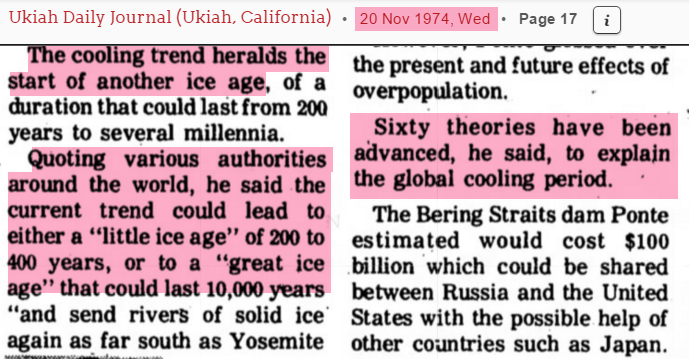
Flashback 1974: ’60 theories have been advanced to explain the global cooling’

By:  – Climate DepotJanuary 12, 2016 9:55 PM with 20 comments

No global warming at all for 18 years 8 months

By Christopher Monckton of Brenchley

The Paris agreement is more dangerous than it appears. Though the secession clause that this column has argued for was inserted into the second draft and remained in the final text, the zombies who have replaced the diplomatic negotiators of almost 200 nations did not – as they should have done in a rational world – insert a sunset clause that would bring the entire costly and pointless process to an end once the observed rate of warming fell far enough below the IPCC’s original predictions in 1990.

It is those first predictions that matter, for they formed the official basis for the climate scam – the biggest transfer of wealth in human history from the poor to the rich, from the little guy to the big guy, from the governed to those who profit by governing them.

Let us hope that the next President of the United States insists on a sunset clause. I propose that if 20 years without global warming occur, the IPCC, the UNFCCC and all their works should be swept into the dustbin of history, and the prosecutors should be brought in. We are already at 18 years 8 months, and counting. The el Niño has shortened the Pause, and will continue to do so for the next few months, but the discrepancy between prediction and reality remains very wide.

clip_image002

Figure 1. The least-squares linear-regression trend on the RSS satellite monthly global mean surface temperature anomaly dataset shows no global warming for 18 years 8 months since May 1997, though one-third of all anthropogenic forcings have occurred during the period of the Pause.

It is worth understanding just how surprised the modelers ought to be by the persistence of the Pause. NOAA, in a very rare fit of honesty, admitted in its 2008 State of the Climatereport that 15 years or more without global warming would demonstrate a discrepancy between prediction and observation. The reason for NOAA’s statement is that there is supposed to be a sharp and significant instantaneous response to a radiative forcing such as adding CO2 to the air.

The steepness of this predicted response can be seen in Fig. 1a, which is based on a paper on temperature feedbacks by Professor Richard Lindzen’s former student Professor Gerard Roe in 2009. The graph of Roe’s model output shows that the initial expected response to a forcing is supposed to be an immediate and rapid warming. But, despite the very substantial forcings in the 18 years 8 months since May 1997, not a flicker of warming has resulted.

clip_image004

Figure 1a: Models predict rapid initial warming in response to a forcing. Instead, no warming at all is occurring. Based on Roe (2009).

The current el Niño, as Bob Tisdale’s distinguished series of reports here demonstrates, is at least as big as the Great el Niño of 1998. The RSS temperature record is now beginning to reflect its magnitude. If past events of this kind are a guide, there will be several months’ further warming before the downturn in the spike begins.

However, if there is a following la Niña, as there often is, the Pause may return at some time from the end of this year onward.

The hiatus period of 18 years 8 months is the farthest back one can go in the RSS satellite temperature record and still show a sub-zero trend. The start date is not cherry-picked: it is calculated. And the graph does not mean there is no such thing as global warming. Going back further shows a small warming rate. The rate on the RSS dataset since it began in 1979 is equivalent to 1.2 degrees/century.

And yes, the start-date for the Pause has been inching forward, though just a little more slowly than the end-date, which is why the Pause has continued on average to lengthen.

The UAH satellite dataset shows a Pause almost as long as the RSS dataset. However, the much-altered surface tamperature datasets show a small warming rate (Fig. 1b).

clip_image006

Figure 1b. The least-squares linear-regression trend on the mean of the GISS, HadCRUT4 and NCDC terrestrial monthly global mean surface temperature anomaly datasets shows global warming at a rate equivalent to 1.1 C° per century during the period of the Pause from May 1997 to September 2015.

Bearing in mind that one-third of the 2.4 W m–2 radiative forcing from all manmade sources since 1750 has occurred during the period of the Pause, a warming rate equivalent to little more than 1 C°/century (even if it had occurred) would not be cause for concern.

As always, a note of caution. Merely because there has been little or no warming in recent decades, one may not draw the conclusion that warming has ended forever. The trend lines measure what has occurred: they do not predict what will occur.

The Pause – politically useful though it may be to all who wish that the “official” scientific community would remember its duty of skepticism – is far less important than the growing discrepancy between the predictions of the general-circulation models and observed reality.

The divergence between the models’ predictions in 1990 (Fig. 2) and 2005 (Fig. 3), on the one hand, and the observed outturn, on the other, continues to widen. If the Pause lengthens just a little more, the rate of warming in the quarter-century since the IPCC’sFirst Assessment Report in 1990 will fall below 1 C°/century equivalent.

clip_image008

Figure 2. Near-term projections of warming at a rate equivalent to 2.8 [1.9, 4.2] K/century, made with “substantial confidence” in IPCC (1990), for the 311 months January 1990 to November 2015 (orange region and red trend line), vs. observed anomalies (dark blue) and trend (bright blue) at just 1 K/century equivalent, taken as the mean of the RSS and UAH v.6 satellite monthly mean lower-troposphere temperature anomalies.

clip_image010

Figure 3. Predicted temperature change, January 2005 to September 2015, at a rate equivalent to 1.7 [1.0, 2.3] Cº/century (orange zone with thick red best-estimate trend line), compared with the near-zero observed anomalies (dark blue) and real-world trend (bright blue), taken as the mean of the RSS and UAH v.6 satellite lower-troposphere temperature anomalies.

The Technical Note explains the sources of the IPCC’s predictions in 1990 and in 2005, and also demonstrates that that according to the ARGO bathythermograph data the oceans are warming at a rate equivalent to less than a quarter of a Celsius degree per century. In a rational scientific discourse, those who had advocated extreme measures to prevent global warming would now be withdrawing and calmly rethinking their hypotheses. However, this is not a rational scientific discourse.

Key facts about global temperature

These facts should be shown to anyone who persists in believing that, in the words of Mr Obama’s Twitteratus, “global warming is real, manmade and dangerous”.

Ø The RSS satellite dataset shows no global warming at all for 224 months from May 1997 to December 2015 – more than half the 444-month satellite record.

Ø There has been no warming even though one-third of all anthropogenic forcings since 1750 have occurred since 1997.

Ø The entire UAH dataset for the 444 months (37 full years) from December 1978 to November 2015 shows global warming at an unalarming rate equivalent to just 1.14 Cº per century.

clip_image012

Ø Since 1950, when a human influence on global temperature first became theoretically possible, the global warming trend has been equivalent to below 1.2 Cº per century.

Ø The global warming trend since 1900 is equivalent to 0.75 Cº per century. This is well within natural variability and may not have much to do with us.

Ø The fastest warming rate lasting 15 years or more since 1950 occurred over the 33 years from 1974 to 2006. It was equivalent to 2.0 Cº per century.

Ø Compare the warming on the Central England temperature dataset in the 40 years 1694-1733, well before the Industrial Revolution, equivalent to 4.33 C°/century.

Ø In 1990, the IPCC’s mid-range prediction of near-term warming was equivalent to 2.8 Cº per century, higher by two-thirds than its current prediction of 1.7 Cº/century.

Ø The warming trend since 1990, when the IPCC wrote its first report, is equivalent to little more than 1 Cº per century. The IPCC had predicted close to thrice as much.

Ø To meet the IPCC’s original central prediction of 1 C° warming from 1990-2025, in the next decade a warming of 0.75 C°, equivalent to 7.5 C°/century, would have to occur.

Ø Though the IPCC has cut its near-term warming prediction, it has not cut its high-end business as usual centennial warming prediction of 4.8 Cº warming to 2100.

Ø The IPCC’s predicted 4.8 Cº warming by 2100 is well over twice the greatest rate of warming lasting more than 15 years that has been measured since 1950.

Ø The IPCC’s 4.8 Cº-by-2100 prediction is four times the observed real-world warming trend since we might in theory have begun influencing it in 1950.

Ø The oceans, according to the 3600+ ARGO buoys, are warming at a rate of just 0.02 Cº per decade, equivalent to 0.23 Cº per century, or 1 C° in 430 years.

Ø Recent extreme-weather events cannot be blamed on global warming, because there has not been any global warming to speak of. It is as simple as that.

Technical note

Our latest topical graph shows the least-squares linear-regression trend on the RSS satellite monthly global mean lower-troposphere dataset for as far back as it is possible to go and still find a zero trend. The start-date is not “cherry-picked” so as to coincide with the temperature spike caused by the 1998 el Niño. Instead, it is calculated so as to find the longest period with a zero trend.

The fact of a long Pause is an indication of the widening discrepancy between prediction and reality in the temperature record.

The satellite datasets are arguably less unreliable than other datasets in that they show the 1998 Great El Niño more clearly than all other datasets. The Great el Niño, like its two predecessors in the past 300 years, caused widespread global coral bleaching, providing an independent verification that the satellite datasets are better able than the rest to capture such fluctuations without artificially filtering them out.

Terrestrial temperatures are measured by thermometers. Thermometers correctly sited in rural areas away from manmade heat sources show warming rates below those that are published. The satellite datasets are based on reference measurements made by the most accurate thermometers available – platinum resistance thermometers, which provide an independent verification of the temperature measurements by checking via spaceward mirrors the known temperature of the cosmic background radiation, which is 1% of the freezing point of water, or just 2.73 degrees above absolute zero. It was by measuring minuscule variations in the cosmic background radiation that the NASA anisotropy probe determined the age of the Universe as 13.82 billion years.

The RSS graph (Fig. 1) is accurate. The data are lifted monthly straight from the RSS website. A computer algorithm reads them down from the text file and plots them automatically using an advanced routine that automatically adjusts the aspect ratio of the data window at both axes so as to show the data at maximum scale, for clarity.

The latest monthly data point is visually inspected to ensure that it has been correctly positioned. The light blue trend line plotted across the dark blue spline-curve that shows the actual data is determined by the method of least-squares linear regression, which calculates the y-intercept and slope of the line.

The IPCC and most other agencies use linear regression to determine global temperature trends. Professor Phil Jones of the University of East Anglia recommends it in one of the Climategate emails. The method is appropriate because global temperature records exhibit little auto-regression, since summer temperatures in one hemisphere are compensated by winter in the other. Therefore, an AR(n) model would generate results little different from a least-squares trend.

Dr Stephen Farish, Professor of Epidemiological Statistics at the University of Melbourne, kindly verified the reliability of the algorithm that determines the trend on the graph and the correlation coefficient, which is very low because, though the data are highly variable, the trend is flat.

RSS itself is now taking a serious interest in the length of the Great Pause. Dr Carl Mears, the senior research scientist at RSS, discusses it at remss.com/blog/recent-slowing-rise-global-temperatures.

Dr Mears’ results are summarized in Fig. T1:

clip_image014

Figure T1. Output of 33 IPCC models (turquoise) compared with measured RSS global temperature change (black), 1979-2014. The transient coolings caused by the volcanic eruptions of Chichón (1983) and Pinatubo (1991) are shown, as is the spike in warming caused by the great el Niño of 1998.

Dr Mears writes:

“The denialists like to assume that the cause for the model/observation discrepancy is some kind of problem with the fundamental model physics, and they pooh-pooh any other sort of explanation.  This leads them to conclude, very likely erroneously, that the long-term sensitivity of the climate is much less than is currently thought.”

Dr Mears concedes the growing discrepancy between the RSS data and the models, but he alleges “cherry-picking” of the start-date for the global-temperature graph:

“Recently, a number of articles in the mainstream press have pointed out that there appears to have been little or no change in globally averaged temperature over the last two decades.  Because of this, we are getting a lot of questions along the lines of ‘I saw this plot on a denialist web site.  Is this really your data?’  While some of these reports have ‘cherry-picked’ their end points to make their evidence seem even stronger, there is not much doubt that the rate of warming since the late 1990s is less than that predicted by most of the IPCC AR5 simulations of historical climate.  … The denialists really like to fit trends starting in 1997, so that the huge 1997-98 ENSO event is at the start of their time series, resulting in a linear fit with the smallest possible slope.”

In fact, the spike in temperatures caused by the Great el Niño of 1998 is almost entirely offset in the linear-trend calculation by two factors: the not dissimilar spike of the 2010 el Niño, and the sheer length of the Great Pause itself. The headline graph in these monthly reports begins in 1997 because that is as far back as one can go in the data and still obtain a zero trend.

clip_image016

Fig. T1a. Graphs for RSS and GISS temperatures starting both in 1997 and in 2001. For each dataset the trend-lines are near-identical, showing conclusively that the argument that the Pause was caused by the 1998 el Nino is false (Werner Brozek and Professor Brown worked out this neat demonstration).

Curiously, Dr Mears prefers the terrestrial datasets to the satellite datasets. The UK Met Office, however, uses the satellite data to calibrate its own terrestrial record.

The length of the Pause, significant though it now is, is of less importance than the ever-growing discrepancy between the temperature trends predicted by models and the far less exciting real-world temperature change that has been observed.

Sources of the IPCC projections in Figs. 2 and 3

IPCC’s First Assessment Report predicted that global temperature would rise by 1.0 [0.7, 1.5] Cº to 2025, equivalent to 2.8 [1.9, 4.2] Cº per century. The executive summary asked, “How much confidence do we have in our predictions?” IPCC pointed out some uncertainties (clouds, oceans, etc.), but concluded:

“Nevertheless, … we have substantial confidence that models can predict at least the broad-scale features of climate change. … There are similarities between results from the coupled models using simple representations of the ocean and those using more sophisticated descriptions, and our understanding of such differences as do occur gives us some confidence in the results.”

That “substantial confidence” was substantial over-confidence. For the rate of global warming since 1990 – the most important of the “broad-scale features of climate change” that the models were supposed to predict – is now below half what the IPCC had then predicted.

In 1990, the IPCC said this:

“Based on current models we predict:

“under the IPCC Business-as-Usual (Scenario A) emissions of greenhouse gases, a rate of increase of global mean temperature during the next century of about 0.3 Cº per decade (with an uncertainty range of 0.2 Cº to 0.5 Cº per decade), this is greater than that seen over the past 10,000 years. This will result in a likely increase in global mean temperature of about 1 Cº above the present value by 2025 and 3 Cº before the end of the next century. The rise will not be steady because of the influence of other factors” (p. xii).

Later, the IPCC said:

“The numbers given below are based on high-resolution models, scaled to be consistent with our best estimate of global mean warming of 1.8 Cº by 2030. For values consistent with other estimates of global temperature rise, the numbers below should be reduced by 30% for the low estimate or increased by 50% for the high estimate” (p. xxiv).

The orange region in Fig. 2 represents the IPCC’s medium-term Scenario-A estimate of near-term warming, i.e. 1.0 [0.7, 1.5] K by 2025.

The IPCC’s predicted global warming over the 25 years from 1990 to the present differs little from a straight line (Fig. T2).

clip_image018

Figure T2. Historical warming from 1850-1990, and predicted warming from 1990-2100 on the IPCC’s “business-as-usual” Scenario A (IPCC, 1990, p. xxii).

Because this difference between a straight line and the slight uptick in the warming rate the IPCC predicted over the period 1990-2025 is so small, one can look at it another way. To reach the 1 K central estimate of warming since 1990 by 2025, there would have to be twice as much warming in the next ten years as there was in the last 25 years. That is not likely.

But is the Pause perhaps caused by the fact that CO2 emissions have not been rising anything like as fast as the IPCC’s “business-as-usual” Scenario A prediction in 1990? No: CO2 emissions have risen rather above the Scenario-A prediction (Fig. T3).

clip_image020

Figure T3. CO2 emissions from fossil fuels, etc., in 2012, from Le Quéré et al. (2014), plotted against the chart of “man-made carbon dioxide emissions”, in billions of tonnes of carbon per year, from IPCC (1990).

Plainly, therefore, CO2 emissions since 1990 have proven to be closer to Scenario A than to any other case, because for all the talk about CO2 emissions reduction the fact is that the rate of expansion of fossil-fuel burning in China, India, Indonesia, Brazil, etc., far outstrips the paltry reductions we have achieved in the West to date.

True, methane concentration has not risen as predicted in 1990 (Fig. T4), for methane emissions, though largely uncontrolled, are simply not rising as the models had predicted. Here, too, all of the predictions were extravagantly baseless.

The overall picture is clear. Scenario A is the emissions scenario from 1990 that is closest to the observed CO2 emissions outturn.

clip_image022

Figure T4. Methane concentration as predicted in four IPCC Assessment Reports, together with (in black) the observed outturn, which is running along the bottom of the least prediction. This graph appeared in the pre-final draft of IPCC (2013), but had mysteriously been deleted from the final, published version, inferentially because the IPCC did not want to display such a plain comparison between absurdly exaggerated predictions and unexciting reality.

To be precise, a quarter-century after 1990, the global-warming outturn to date – expressed as the least-squares linear-regression trend on the mean of the RSS and UAH monthly global mean surface temperature anomalies – is 0.27 Cº, equivalent to little more than 1 Cº/century. The IPCC’s central estimate of 0.71 Cº, equivalent to 2.8 Cº/century, that was predicted for Scenario A in IPCC (1990) with “substantial confidence” was approaching three times too big. In fact, the outturn is visibly well below even the least estimate.

In 1990, the IPCC’s central prediction of the near-term warming rate was higher by two-thirds than its prediction is today. Then it was 2.8 C/century equivalent. Now it is just 1.7 Cº equivalent – and, as Fig. T5 shows, even that is proving to be a substantial exaggeration.

Is the ocean warming?

One frequently-discussed explanation for the Great Pause is that the coupled ocean-atmosphere system has continued to accumulate heat at approximately the rate predicted by the models, but that in recent decades the heat has been removed from the atmosphere by the ocean and, since globally the near-surface strata show far less warming than the models had predicted, it is hypothesized that what is called the “missing heat” has traveled to the little-measured abyssal strata below 2000 m, whence it may emerge at some future date.

Actually, it is not known whether the ocean is warming: each of the 3600 automated ARGO bathythermograph buoys takes just three measurements a month in 200,000 cubic kilometres of ocean – roughly a 100,000-square-mile box more than 316 km square and 2 km deep. Plainly, the results on the basis of a resolution that sparse (which, as Willis Eschenbach puts it, is approximately the equivalent of trying to take a single temperature and salinity profile taken at a single point in Lake Superior less than once a year) are not going to be a lot better than guesswork.

Unfortunately ARGO seems not to have updated the ocean dataset since December 2014. However, what we have gives us 11 full years of data. Results are plotted in Fig. T5. The ocean warming, if ARGO is right, is equivalent to just 0.02 Cº decade–1, equivalent to 0.2 Cº century–1.

clip_image024

Figure T5. The entire near-global ARGO 2 km ocean temperature dataset from January 2004 to December 2014 (black spline-curve), with the least-squares linear-regression trend calculated from the data by the author (green arrow).

Finally, though the ARGO buoys measure ocean temperature change directly, before publication NOAA craftily converts the temperature change into zettajoules of ocean heat content change, which make the change seem a whole lot larger.

The terrifying-sounding heat content change of 260 ZJ from 1970 to 2014 (Fig. T6) is equivalent to just 0.2 K/century of global warming. All those “Hiroshima bombs of heat” of which the climate-extremist websites speak are a barely discernible pinprick. The ocean and its heat capacity are a lot bigger than some may realize.

clip_image026

Figure T6. Ocean heat content change, 1957-2013, in Zettajoules from NOAA’s NODC Ocean Climate Lab: http://www.nodc.noaa.gov/OC5/3M_HEAT_CONTENT, with the heat content values converted back to the ocean temperature changes in Kelvin that were originally measured. NOAA’s conversion of the minuscule warming data to Zettajoules, combined with the exaggerated vertical aspect of the graph, has the effect of making a very small change in ocean temperature seem considerably more significant than it is.

Converting the ocean heat content change back to temperature change reveals an interesting discrepancy between NOAA’s data and that of the ARGO system. Over the period of ARGO data, from 2004-2014, the NOAA data imply that the oceans are warming at 0.05 Cº decade–1, equivalent to 0.5 Cº century–1, or rather more than double the rate shown by ARGO.

ARGO has the better-resolved dataset, but since the resolutions of all ocean datasets are very low one should treat all these results with caution.

What one can say is that, on such evidence as these datasets are capable of providing, the difference between underlying warming rate of the ocean and that of the atmosphere is not statistically significant, suggesting that if the “missing heat” is hiding in the oceans it has magically found its way into the abyssal strata without managing to warm the upper strata on the way.

On these data, too, there is no evidence of rapid or catastrophic ocean warming.

Furthermore, to date no empirical, theoretical or numerical method, complex or simple, has yet successfully specified mechanistically either how the heat generated by anthropogenic greenhouse-gas enrichment of the atmosphere has reached the deep ocean without much altering the heat content of the intervening near-surface strata or how the heat from the bottom of the ocean may eventually re-emerge to perturb the near-surface climate conditions relevant to land-based life on Earth.

clip_image028

Figure T7. Near-global ocean temperatures by stratum, 0-1900 m, providing a visual reality check to show just how little the upper strata are affected by minor changes in global air surface temperature. Source: ARGO marine atlas.

Most ocean models used in performing coupled general-circulation model sensitivity runs simply cannot resolve most of the physical processes relevant for capturing heat uptake by the deep ocean.

Ultimately, the second law of thermodynamics requires that any heat which may have accumulated in the deep ocean will dissipate via various diffusive processes. It is not plausible that any heat taken up by the deep ocean will suddenly warm the upper ocean and, via the upper ocean, the atmosphere.

If the “deep heat” explanation for the Pause were correct (and it is merely one among dozens that have been offered), the complex models have failed to account for it correctly: otherwise, the growing discrepancy between the predicted and observed atmospheric warming rates would not have become as significant as it has.

In early October 2015 Steven Goddard added some very interesting graphs to his website. The graphs show the extent to which sea levels have been tampered with to make it look as though there has been sea-level rise when it is arguable that in fact there has been little or none.

Why were the models’ predictions exaggerated?

In 1990 the IPCC predicted – on its business-as-usual Scenario A – that from the Industrial Revolution till the present there would have been 4 Watts per square meter of radiative forcing caused by Man (Fig. T8):

clip_image030

Figure T8. Predicted manmade radiative forcings (IPCC, 1990).

However, from 1995 onward the IPCC decided to assume, on rather slender evidence, that anthropogenic particulate aerosols – mostly soot from combustion – were shading the Earth from the Sun to a large enough extent to cause a strong negative forcing. It has also now belatedly realized that its projected increases in methane concentration were wild exaggerations. As a result of these and other changes, it now estimates that the net anthropogenic forcing of the industrial era is just 2.3 Watts per square meter, or little more than half its prediction in 1990 (Fig. T9):

clip_image032

Figure T9: Net anthropogenic forcings, 1750 to 1950, 1980 and 2012 (IPCC, 2013).

Even this, however, may be a considerable exaggeration. For the best estimate of the actual current top-of-atmosphere radiative imbalance (total natural and anthropo-genic net forcing) is only 0.6 Watts per square meter (Fig. T10):

clip_image034

Figure T10. Energy budget diagram for the Earth from Stephens et al. (2012)

In short, most of the forcing predicted by the IPCC is either an exaggeration or has already resulted in whatever temperature change it was going to cause. There is little global warming in the pipeline as a result of our past and present sins of emission.

It is also possible that the IPCC and the models have relentlessly exaggerated climate sensitivity. One recent paper on this question is Monckton of Brenchley et al. (2015), which found climate sensitivity to be in the region of 1 Cº per CO2 doubling (go to scibull.com and click “Most Read Articles”). The paper identified errors in the models’ treatment of temperature feedbacks and their amplification, which account for two-thirds of the equilibrium warming predicted by the IPCC.

Professor Ray Bates gave a paper in Moscow in summer 2015 in which he concluded, based on the analysis by Lindzen & Choi (2009, 2011) (Fig. T10), that temperature feedbacks are net-negative. Accordingly, he supports the conclusion both by Lindzen & Choi (1990) (Fig. T11) and by Spencer & Braswell (2010, 2011) that climate sensitivity is below – and perhaps considerably below – 1 Cº per CO2 doubling.

clip_image036

Figure T11. Reality (center) vs. 11 models. From Lindzen & Choi (2009).

A growing body of reviewed papers find climate sensitivity considerably below the 3 [1.5, 4.5] Cº per CO2 doubling that was first put forward in the Charney Report of 1979 for the U.S. National Academy of Sciences, and is still the IPCC’s best estimate today.

On the evidence to date, therefore, there is no scientific basis for taking any action at all to mitigate CO2 emissions.

Finally, how long will it be before the Freedom Clock (Fig. T12) reaches 20 years without any global warming? If it does, the climate scare will become unsustainable.

clip_image038

Figure T12. The Freedom Clock edges ever closer to 20 years without global warming

#

Related Links: 

It’s Official – There are now 66 excuses for Temp ‘pause’ – Updated list of 66 excuses for the 18-26 year ‘pause’ in global warming

Flashback: 1990 NASA Report: ‘Satellite analysis of upper atmosphere is more accurate, & should be adopted as the standard way to monitor temp change.’

April 1990 – The Canberra Times: ‘A report Issued by the U.S. space agency NASA…’

‘The [NASA] report’s authors said that their satellite analysis of the upper atmosphere is more accurate, and should be adopted as the standard way to monitor temperature change.’

ScreenHunter_1303 Jan. 07 11.06

Real Science website analysis: ‘Twenty-four years later, NASA and NOAA ignore the more accurate satellite data – and report only useless, tampered surface temperatures.’

Flashback 1974: ’60 theories have been advanced to explain the global cooling’ – In the 1970’s scientists were predicting a new ice age, and had 60 theories to explain it.: – Ukiah Daily Journal 0 November 20, 1974 – “The cooling trend heralds the start of another ice age, of a duration that could last form 200 years to several milenia…Sixty theories have been advanced, he said, to explain the global cooling period.”

Read more: http://www.climatedepot.com/2016/01/12/satellites-no-global-warming-at-all-for-18-years-8-months/#ixzz3zVi4s7KY

“TAC” DÜNYALARIN GÜZELİ

  • Şubat 2, 2016
Dünyanın en güzel okulları listesine Türkiye’den bir okul da girdi!
Dünyanın en güzel okulları listesine Türkiye’den de bir okul girdi. Tarsus Amerikan Koleji, dünyanın en güzel 13 okulu arasında gösterildi.

Türkiye’nin en köklü okullarından Tarsus Amerikan Koleji’nin (TAC) 137 yıllık tarihi kampüsü, dünyanın en güzel okulları listesine girdi.

Tech Insider: “Gündüz saatlerinde TAC-TSEV’in yeni kampüsü bir iş merkezi gibi görünmekte, akşam güneş battığında ise kampüsten sıcak turuncu bir parıltı yayılmaktadır”

Uluslararası bağımsız haber sitesi Tech Insider, dünya çapında yaptığı araştırma sonunda, Tarsus’taki Tarsus Amerikan Koleji ve Tarsus SEV İlköğretim Okulu’nu, ‘Dünyanın En Güzel 13 Okulu’ listesinde gösterdi.

Haber, bilgi, analiz, görüş ve yorumlara yer veren uluslararası bağımsız web sitesi http://www.techinsider.io; ‘Dünyanın En Güzel 13 Okulu’ başlıklı yaptığı araştırmayla; Avustralya’dan Nijerya’ya, Kamboçya’dan Danimarka’ya dünyanın dört bir yanındaki okulları süzgeçten geçirdi.

Dünyadaki binlerce okul arasında yapılan araştırmanın sonunda, Türkiye’den Tarsus Amerikan Koleji (TAC), etkileyici tarihi kampüsüyle listede yer aldı.

Business Insider adlı elektronik gazetenin bir kolu olan uluslararası web sitesi Tech Insider, ‘Dünyanın En Güzel 13 Okulu’ listesini ve favori okulları şöyle sıraladı:

1- Nijerya (Lagos)
2- Avusturalya (Melbourne)
3- Türkiye (Tarsus)
4- Avustralya (Niddrie)
5- İsveç (Kungsbacka)
6- Tayland (Bangkok)
7- Kamboçya
8- Singapur
9- Çin
10- Danimarka (Kopenhag)
11/12- Japonya (Tokyo’dan iki okul)
13- Rusya

Araştırma ile ilgili Tech Insider sitesinde şu açıklama yapıldı: 

“Öğrenme; uyarıcı, canlandırıcı ve ilgi çekici bir deneyimdir. Okulların da aynı şekilde etkileyici olması gerekmez mi? Avustralya’dan Nijerya’ya, Kamboçya’dan Danimarka’ya dünyanın her yerinde güzel okullar bulunabilir. Bazıları çocuklara teknolojinin inceliklerini öğretirken, bazıları da bu deneyimden yoksun kalan maddi durumu yetersiz çocuklara ilk kez eğitim verirler.”

En güzel okullar listesinde, Tarsus Amerikan Koleji (TAC) ve Tarsus SEV İlköğretim Okulu’na (TSEV) yer veren Tech Insider, neden Tarsus’u seçtiğini ise; 

“Gündüz saatlerinde TAC-TSEV’in yeni kampüsü bir iş merkezi gibi görünmekte, akşam güneş battığında ise kampüsten sıcak turuncu bir parıltı yayılmaktadır” ifadeleriyle açıkladı.

Tarsus Amerikan Koleji ile Tarsus SEV İlköğretim Okulu’nun bulunduğu kampüs, geçmişi ve geleceği bir arada harmanlıyor. TAC’nin neredeyse bir buçuk asırlık geçmişe sahip kampüsünün karşısında kurulan Tarsus SEV’in yeni ve modern binası, altı büyük mimari ödül aldı. Yaklaşık 30 bin metrekarelik kampüste yer alan binada; TAC’nin yatakhanesi, iki okulun ortak kullandığı oditoryum, yemekhane ve kapalı spor salonu yer alıyor. İlköğretim okulunun binasında; anaokulundan dördüncü sınıfa kadar olan ilköğretim öğrencileri eğitim alırken, aynı kampüste bulunan diğer bina ise TAC’nin yatılı okuyan lise öğrencilerine ev sahipliği yapıyor.

Haberin yer aldığı linke http://www.techinsider.io/most-beautiful-schools-in-the-world-2016-1 adresinden ulaşılabilir.

A WORLD WITHOUT MOSQUITOS

Published online 21 July 2010 | Nature 466, 432-434 (2010) | doi:10.1038/466432a

Ecology: A world without mosquitoes

Eradicating any organism would have serious consequences for ecosystems — wouldn’t it? Not when it comes to mosquitoes, finds Janet Fang.

Janet Fang

Every day, Jittawadee Murphy unlocks a hot, padlocked room at the Walter Reed Army Institute of Research in Silver Spring, Maryland, to a swarm of malaria-carrying mosquitoes (Anopheles stephensi). She gives millions of larvae a diet of ground-up fish food, and offers the gravid females blood to suck from the bellies of unconscious mice — they drain 24 of the rodents a month. Murphy has been studying mosquitoes for 20 years, working on ways to limit the spread of the parasites they carry. Still, she says, she would rather they were wiped off the Earth.

That sentiment is widely shared. Malaria infects some 247 million people worldwide each year, and kills nearly one million. Mosquitoes cause a huge further medical and financial burden by spreading yellow fever, dengue fever, Japanese encephalitis, Rift Valley fever, Chikungunya virus and West Nile virus. Then there’s the pest factor: they form swarms thick enough to asphyxiate caribou in Alaska and now, as their numbers reach a seasonal peak, their proboscises are plunged into human flesh across the Northern Hemisphere.

So what would happen if there were none? Would anyone or anything miss them?  Nature put this question to scientists who explore aspects of mosquito biology and ecology, and unearthed some surprising answers.

There are 3,500 named species of mosquito, of which only a couple of hundred bite or bother humans. They live on almost every continent and habitat, and serve important functions in numerous ecosystems. “Mosquitoes have been on Earth for more than 100 million years,” says Murphy, “and they have co-evolved with so many species along the way.” Wiping out a species of mosquito could leave a predator without prey, or a plant without a pollinator. And exploring a world without mosquitoes is more than an exercise in imagination: intense efforts are under way to develop methods that might rid the world of the most pernicious, disease-carrying species (see ‘War against the winged’).

Yet in many cases, scientists acknowledge that the ecological scar left by a missing mosquito would heal quickly as the niche was filled by other organisms. Life would continue as before — or even better. When it comes to the major disease vectors, “it’s difficult to see what the downside would be to removal, except for collateral damage”, says insect ecologist Steven Juliano, of Illinois State University in Normal. A world without mosquitoes would be “more secure for us”, says medical entomologist Carlos Brisola Marcondes from the Federal University of Santa Catarina in Brazil. “The elimination of  Anopheles would be very significant for mankind.” 

Arctic pests

Elimination of mosquitoes might make the biggest ecological difference in the Arctic tundra, home to mosquito species including  Aedes impiger and Aedes nigripes. Eggs laid by the insects hatch the next year after the snow melts, and development to adults takes only 3–4 weeks. From northern Canada to Russia, there is a brief period in which they are extraordinarily abundant, in some areas forming thick clouds. “That’s an exceptionally rare situation worldwide,” says entomologist Daniel Strickman, programme leader for medical and urban entomology at the US Department of Agriculture in Beltsville, Maryland. “There is no other place in the world where they are that much biomass.”

“If there was a benefit to having them around, we would have found a way to exploit them. We haven’t wanted anything from mosquitoes except for them to go away.”


Views differ on what would happen if that biomass vanished. Bruce Harrison, an entomologist at the North Carolina Department of Environment and Natural Resources in Winston-Salem estimates that the number of migratory birds that nest in the tundra could drop by more than 50% without mosquitoes to eat. Other researchers disagree. Cathy Curby, a wildlife biologist at the US Fish and Wildlife Service in Fairbanks, Alaska, says that Arctic mosquitoes don’t show up in bird stomach samples in high numbers, and that midges are a more important source of food. “We (as humans) may overestimate the number of mosquitoes in the Arctic because they are selectively attracted to us,” she says.

Mosquitoes consume up to 300 millilitres of blood a day from each animal in a caribou herd, which are thought to select paths facing into the wind to escape the swarm. A small change in path can have major consequences in an Arctic valley through which thousands of caribou migrate, trampling the ground, eating lichens, transporting nutrients, feeding wolves, and generally altering the ecology. Taken all together, then, mosquitoes would be missed in the Arctic — but is the same true elsewhere? 

Food on the wing

“Mosquitoes are delectable things to eat and they’re easy to catch,” says aquatic entomologist Richard Merritt, at Michigan State University in East Lansing. In the absence of their larvae, hundreds of species of fish would have to change their diet to survive. “This may sound simple, but traits such as feeding behaviour are deeply imprinted, genetically, in those fish,” says Harrison. The mosquitofish (Gambusia affinis), for example, is a specialized predator — so effective at killing mosquitoes that it is stocked in rice fields and swimming pools as pest control — that could go extinct. And the loss of these or other fish could have major effects up and down the food chain.

Many species of insect, spider, salamander, lizard and frog would also lose a primary food source. In one study published last month, researchers tracked insect-eating house martins at a park in Camargue, France, after the area was sprayed with a microbial mosquito-control agent1. They found that the birds produced on average two chicks per nest after spraying, compared with three for birds at control sites.

Most mosquito-eating birds would probably switch to other insects that, post-mosquitoes, might emerge in large numbers to take their place. Other insectivores might not miss them at all: bats feed mostly on moths, and less than 2% of their gut content is mosquitoes. “If you’re expending energy,” says medical entomologist Janet McAllister of the Centers for Disease Control and Prevention in Fort Collins, Colorado, “are you going to eat the 22-ounce filet-mignon moth or the 6-ounce hamburger mosquito?”

With many options on the menu, it seems that most insect-eaters would not go hungry in a mosquito-free world. There is not enough evidence of ecosystem disruption here to give the eradicators pause for thought. 

At your service

As larvae, mosquitoes make up substantial biomass in aquatic ecosystems globally. They abound in bodies of water ranging from ephemeral ponds to tree holes2 to old tyres, and the density of larvae on flooded plains can be so high that their writhing sends out ripples across the surface. They feed on decaying leaves, organic detritus and microorganisms. The question is whether, without mosquitoes, other filter feeders would step in. “Lots of organisms process detritus. Mosquitoes aren’t the only ones involved or the most important,” says Juliano. “If you pop one rivet out of an airplane’s wing, it’s unlikely that the plane will cease to fly.”

Mosquito larvae form a substantial part of the biomass in water pools worldwide.Mosquito larvae form a substantial part of the biomass in water pools worldwide.M. & P. FOGDEN/MINDEN PICTURES/FLPA


The effects might depend on the body of water in question. Mosquito larvae are important members of the tight-knit communities in the 25–100-millilitre pools inside pitcher plants3,4(Sarracenia purpurea) on the east coast of North America. Species of mosquito (Wyeomyia smithii) and midge (Metriocnemus knabi) are the only insects that live there, along with microorganisms such as rotifers, bacteria and protozoa. When other insects drown in the water, the midges chew up their carcasses and the mosquito larvae feed on the waste products, making nutrients such as nitrogen available for the plant. In this case, eliminating mosquitoes might affect plant growth.

In 1974, ecologist John Addicott, now at the University of Calgary in Alberta, Canada, published findings on the predator and prey structure within pitcher plants, noting more protozoan diversity in the presence of mosquito larvae5. He proposed that as the larvae feed, they keep down the numbers of the dominant species of protozoa, letting others persist. The broader consequences for the plant are not known.

A stronger argument for keeping mosquitoes might be found if they provide ‘ecosystem services’ — the benefits that humans derive from nature. Evolutionary ecologist Dina Fonseca at Rutgers University in New Brunswick, New Jersey, points as a comparison to the biting midges of the family Ceratopogonidae, sometimes known as no-see-ums. “People being bitten by no-see-ums or being infected through them with viruses, protozoa and filarial worms would love to eradicate them,” she says. But because some ceratopogonids are pollinators of tropical crops such as cacao, “that would result in a world without chocolate”.

Without mosquitoes, thousands of plant species would lose a group of pollinators. Adults depend on nectar for energy (only females of some species need a meal of blood to get the proteins necessary to lay eggs). Yet McAllister says that their pollination isn’t crucial for crops on which humans depend. “If there was a benefit to having them around, we would have found a way to exploit them,” she says. “We haven’t wanted anything from mosquitoes except for them to go away.”

Ultimately, there seem to be few things that mosquitoes do that other organisms can’t do just as well — except perhaps for one. They are lethally efficient at sucking blood from one individual and mainlining it into another, providing an ideal route for the spread of pathogenic microbes.

“The ecological effect of eliminating harmful mosquitoes is that you have more people. That’s the consequence,” says Strickman. Many lives would be saved; many more would no longer be sapped by disease. Countries freed of their high malaria burden, for example in sub-Saharan Africa, might recover the 1.3% of growth in gross domestic product that the World Health Organization estimates they are cost by the disease each year, potentially accelerating their development. There would be “less burden on the health system and hospitals, redirection of public-health expenditure for vector-borne diseases control to other priority health issues, less absenteeism from schools”, says Jeffrey Hii, malaria scientist for the World Health Organization in Manila.

Phil Lounibos, an ecologist at the Florida Medical Entomology Laboratory in Vero Beach says that “eliminating mosquitoes would temporarily relieve human suffering”. His work suggests that efforts to eradicate one vector species would be futile, as its niche would quickly be filled by another. His team collected female yellow-fever mosquitoes (Aedes aegypti) from scrap yards in Florida, and found that some had been inseminated by Asian tiger mosquitoes (Aedes albopictus), which carry multiple human diseases. The insemination sterilizes the female yellow-fever mosquitoes — showing how one insect can overtake another.

ADVERTISEMENT


Given the huge humanitarian and economic consequences of mosquito-spread disease, few scientists would suggest that the costs of an increased human population would outweigh the benefits of a healthier one. And the ‘collateral damage’ felt elsewhere in ecosystems doesn’t buy much sympathy either. The romantic notion of every creature having a vital place in nature may not be enough to plead the mosquito’s case. It is the limitations of mosquito-killing methods, not the limitations of intent, that make a world without mosquitoes unlikely.

And so, while humans inadvertently drive beneficial species, from tuna to corals, to the edge of extinction, their best efforts can’t seriously threaten an insect with few redeeming features. “They don’t occupy an unassailable niche in the environment,” says entomologist Joe Conlon, of the American Mosquito Control Association in Jacksonville, Florida. “If we eradicated them tomorrow, the ecosystems where they are active will hiccup and then get on with life. Something better or worse would take over.” 

Janet Fang is an intern in Nature’s Washington DC office.

THE CLIMATE SNOW JOB

SCIENCE VS POLITICS

A big storm nowadays is bound to trigger media discussion of the alleged role of greenhouse gases in extreme weather events. But Patrick Michaels writes, “As data from the world’s biggest reinsurer, Munich Re, and University of Colorado environmental-studies professor Roger Pielke Jr. have shown, weather-related losses haven’t increased at all over the past quarter-century. In fact, the trend, while not statistically significant, is downward.”

But what about the impact of those gases on global temperatures? “Until last June, most scientists acknowledged that warming reached a peak in the late 1990s, and since then had plateaued in a ‘hiatus.’ There are about 60 different explanations for this in the refereed literature,” writes Mr. Michaels. “That changed last summer, when the National Oceanic and Atmospheric Administration (NOAA) decided to overhaul its data, throwing out satellite-sensed sea-surface temperatures since the late 1970s and instead relying on, among other sources, readings taken from the cooling-water-intake tubes of oceangoing vessels. The scientific literature is replete with articles about the large measurement errors that accrue in this data,” he adds.

THE CLIMATE SNOW JOB
By 

PATRICK J. MICHAELS

Jan. 24, 2016 2:45 p.m. ET

An East Coast blizzard howling, global temperatures peaking, the desert Southwest flooding, drought-stricken California drying up—surely there’s a common thread tying together this “extreme” weather. There is. But it has little to do with what recent headlines have been saying about the hottest year ever. It is called business as usual.

Surface temperatures are indeed increasing slightly: They’ve been going up, in fits and starts, for more than 150 years, or since a miserably cold and pestilential period known as the Little Ice Age. Before carbon dioxide from economic activity could have warmed us up, temperatures rose three-quarters of a degree Fahrenheit between 1910 and World War II. They then cooled down a bit, only to warm again from the mid-1970s to the late ’90s, about the same amount as earlier in the century.

Whether temperatures have warmed much since then depends on what you look at. Until last June, most scientists acknowledged that warming reached a peak in the late 1990s, and since then had plateaued in a “hiatus.” There are about 60 different explanations for this in the refereed literature.

That changed last summer, when the National Oceanic and Atmospheric Administration (NOAA) decided to overhaul its data, throwing out satellite-sensed sea-surface temperatures since the late 1970s and instead relying on, among other sources, readings taken from the cooling-water-intake tubes of oceangoing vessels. The scientific literature is replete with articles about the large measurement errors that accrue in this data owing to the fact that a ship’s infrastructure conducts heat, absorbs a tremendous amount of the sun’s energy, and vessels’ intake tubes are at different ocean depths. See, for instance, John J. Kennedy’s “A review of uncertainty in in situ measurements and data sets of sea surface temperature,” published Jan. 24, 2014, by the journal Reviews of Geophysics. 

NOAA’s alteration of its measurement standard and other changes produced a result that could have been predicted: a marginally significant warming trend in the data over the past several years, erasing the temperature plateau that vexed climate alarmists have found difficult to explain. Yet the increase remains far below what had been expected.

It is nonetheless true that 2015 shows the highest average surface temperature in the 160-year global history since reliable records started being available, with or without the “hiatus.” But that is also not very surprising. Early in 2015, a massive El Niño broke out. These quasiperiodic reversals of Pacific trade winds and deep-ocean currents are well-documented but poorly understood. They suppress the normally massive upwelling of cold water off South America that spreads across the ocean (and is the reason that Lima may be the most pleasant equatorial city on the planet). The Pacific reversal releases massive amounts of heat, and therefore surface temperature spikes. El Niño years in a warm plateau usually set a global-temperature record. What happened this year also happened with the last big one, in 1998. 

Global average surface temperature in 2015 popped up by a bit more than a quarter of a degree Fahrenheit compared with the previous year. In 1998 the temperature rose by slightly less than a quarter-degree from 1997.

When the Pacific circulation returns to its more customary mode, all that suppressed cold water will surge to the surface with a vengeance, and global temperatures will drop. Temperatures in 1999 were nearly three-tenths of a degree lower than in 1998, and a similar change should occur this time around, though it might not fit so neatly into a calendar year. Often the compensatory cooling, known as La Niña, is larger than the El Niño warming.

There are two real concerns about warming, neither of which has anything to do with the El Niño-enhanced recent peak. How much more is the world likely to warm as civilization continues to exhale carbon dioxide, and does warming make the weather more “extreme,” which means more costly? 

Instead of relying on debatable surface-temperature information, consider instead readings in the free atmosphere (technically, the lower troposphere) taken by two independent sensors: satellite sounders and weather balloons. As has been shown repeatedly by University of Alabama climate scientist John Christy, since late 1978 (when the satellite record begins), the rate of warming in the satellite-sensed data is barely a third of what it was supposed to have been, according to the large family of global climate models now in existence. Balloon data, averaged over the four extant data sets, shows the same. 

It is therefore probably prudent to cut by 50% the modeled temperature forecasts for the rest of this century. Doing so would mean that the world—without any political effort at all—won’t warm by the dreaded 3.6 degrees Fahrenheit by 2100 that the United Nations regards as the climate apocalypse.

The notion that world-wide weather is becoming more extreme is just that: a notion, or a testable hypothesis. As data from the world’s biggest reinsurer, Munich Re, and University of Colorado environmental-studies professor Roger Pielke Jr. have shown, weather-related losses haven’t increased at all over the past quarter-century. In fact, the trend, while not statistically significant, is downward. Last year showed the second-smallest weather-related loss of Global World Productivity, or GWP, in the entire record.

Without El Niño, temperatures in 2015 would have been typical of the post-1998 regime. And, even with El Niño, the effect those temperatures had on the global economy was de minimis.

Mr. Michaels, a climatologist, is the director of the Center for the Study of Science at the Cato Institute.

The Climate Snow Job

A blizzard! The hottest year ever! More signs that global warming and its extreme effects are beyond debate, right? Not even close.


The Climate Snow Job

A blizzard! The hottest year ever! More signs that global warming and its extreme effects are beyond debate, right? Not even close.

On the National Mall in Washington, D.C., Jan. 23.
On the National Mall in Washington, D.C., Jan. 23. PHOTO: BRENDAN SMIALOWSKI/AGENCE FRANCE-PRESSE/GETTY IMAGE