İLHAN’IN DİŞİ
Under an icy crust, one of Saturn’s smallest moons harbors a pool of water equal to the largest lakes on Earth, adding to evidence that the frigid outlands of the solar system may be suitable for the chemistry of life. Robert Lee Hotz reports. Photo: AP.
Under an icy crust, one of Saturn’s smallest moons harbors a pool of water equal to the largest lakes on Earth, adding to evidence that the frigid outlands of the solar system may be suitable for the chemistry of life, planetary scientists in the U.S. and Italy said Thursday.
This illustration shows the possible interior of Enceladus—an icy outer shell and a rocky core with a water ocean sandwiched in between the two at southern latitudes.NASA/Associated Press
The subsurface lake on the moon Enceladus was revealed by gravity measurements made by the National Aeronautics and Space Administration’s Cassini probe, which has been traveling among Saturn’s moons for the past decade. The scientists, who reported their work in Science, said the moon has a reservoir of water beneath a sheath of ice 18 to 24 miles thick.
“It is as large as or larger than Lake Superior,” said planetary scientist David Stevenson at the California Institute of Technology, who was part of the research team led by aerospace engineer Luciano Iess at the Sapienza University of Rome.
In 2005, the Cassini probe detected water vapor and ice spewing from vents near the moon’s South Pole, where the subsurface lake is located. The researchers believe the lake rests directly on a bed of silicate rocks that could leach organic chemicals into the water.

The “tiger stripes” on Enceladus are long fractures from which water-vapor jets are emitted. NASA/Associated Press
“It makes the interior of Enceladus an attractive place to look for life,” said astrobiologist Jonathan Lunine at Cornell University in Ithaca, N.Y.
Write to Robert Lee Hotz at sciencejournal@wsj.com
Hugh Herr is building the next generation of bionic limbs, robotic prosthetics inspired by nature’s own designs. Herr lost both legs in a climbing accident 30 years ago; now, as the head of the MIT Media Lab’s Biomechatronics group, he shows his incredible technology in a talk that’s both technical and deeply personal — with the help of ballroom dancer Adrianne Haslet-Davis, who lost her left leg in the 2013 Boston Marathon bombing, and performs again for the first time on the TED stage.
“Physics Exam”
The following concerns a question in a physics degree
exam at the University of Copenhagen:
“Describe how to determine the height of a skyscraper
using a barometer.”
One student replied:
“You tie a long piece of string to the neck of the
barometer, then lower the barometer from the roof of
the skyscraper to the ground. The length of the string
plus the length of the barometer will equal the height
of the building.”
This highly original answer so incensed the examiner
that the student was failed. The student appealed on
the grounds that his answer was indisputably correct,
and the university appointed an independent arbiter to
decide the case. The arbiter judged that the answer
was indeed correct, but did not display any noticeable
knowledge of physics. To resolve the problem it was
decided to call the student in and allow him six
minutes in which to provide a verbal answer which
showed at least a minimal familiarity the basic
principles of physics.
For five minutes the student sat in silence, forehead
creased in thought. The arbiter reminded him that time
was running out, to which the student replied that he
had several extremely relevant answers, but couldn’t
make up his mind which to use.
On being advised to hurry up the student replied as
follows:
“Firstly, you could take the barometer up to the roof
of the skyscraper, drop it over the edge, and measure
the time it takes to reach the ground. The height of
the building can then be worked out from the formula
H = 0.5g x t squared. But bad luck on the barometer.”
“Or if the sun is shining you could measure the height
of the barometer, then set it on end and measure the
length of its shadow. Then you measure the length of
the skyscraper’s shadow, and thereafter it is a simple
matter of proportional arithmetic to work out the
height of the skyscraper.”
“But if you wanted to be highly scientific about it,
you could tie a short piece of string to the barometer
and swing it like a pendulum, first at ground level and
then on the roof of the skyscraper. The height is
worked out by the difference in the gravitational
restoring force T = 2 pi sq root (l / g).”
“Or if the skyscraper has an outside emergency
staircase, it would be easier to walk up it and mark
off the height of the skyscraper in barometer lengths,
then add them up.”
“If you merely wanted to be boring and orthodox about
it, of course, you could use the barometer to measure
the air pressure on the roof of the skyscraper and on
the ground, and convert the difference in millibars
into feet to give the height of the building.”
“But since we are constantly being exhorted to exercise
independence of mind and apply scientific methods,
undoubtedly the best way would be to knock on the
janitor’s door and say to him, ‘If you would like a nice
new barometer, I will give you this one if you tell me
the height of this skyscraper’.”
The student was Niels Bohr, the only person from
Denmark to win the Nobel prize for Physics.
Niels Henrik David BOHR : (PLEASE CLICK)


The forthcoming report apparently admits that climate change has extinguished no species so far and expresses “very little confidence” that it will do so. There is new emphasis that climate change is not the only environmental problem that matters and on adapting to it rather than preventing it. Yet the report still assumes 70% more warming by the last decades of this century than the best science now suggests. This is because of an overreliance on models rather than on data in the first section of the IPCC report—on physical science—that was published in September 2013.
In this space on Dec. 19, 2012, I forecast that the IPCC was going to have to lower its estimates of future warming because of new sensitivity results. (Sensitivity is the amount of warming due to a doubling of atmospheric carbon dioxide.) “Cooling Down Fears of Climate Change” (Dec. 19), led to a storm of protest, in which I was called “anti-science,” a “denier” and worse.
The IPCC’s September 2013 report abandoned any attempt to estimate the most likely “sensitivity” of the climate to a doubling of atmospheric carbon dioxide. The explanation, buried in a technical summary not published until January, is that “estimates derived from observed climate change tend to best fit the observed surface and ocean warming for [sensitivity] values in the lower part of the likely range.” Translation: The data suggest we probably face less warming than the models indicate, but we would rather not say so.
The Global Warming Policy Foundation, a London think tank, published a careful survey of all the reliable studies of sensitivity on March 5. The authors are British climate scientist Nic Lewis (who has no academic affiliation but a growing reputation since he discovered a glaring statistical distortion that exaggerated climate sensitivity in the previous IPCC report) and the Dutch science writer Marcel Crok. They say the IPCC’s September report “buried good news about global warming,” and that “the best observational evidence indicates our climate is considerably less sensitive to greenhouse gases than climate scientists had previously thought.”
Messrs. Lewis and Crok argue that the average of the best observationally based studies shows the amount of immediate warming to be expected if carbon dioxide levels double after 70 years is “likely” to be between one and two degrees Centigrade, with a best estimate of 1.35C (or 2.4F). That’s much lower than the IPCC assumes in its forthcoming report.
In short, the warming we experienced over the past 35 years—about 0.4C (or 0.7F) if you average the measurements made by satellites and those made by ground stations—is likely to continue at about the same rate: a little over a degree a century.
Briefly during the 1990s there did seem to be warming that went as fast as the models wanted. But for the past 15-17 years there has been essentially no net warming (a “hiatus” now conceded by the IPCC), a fact that the models did not predict and now struggle to explain. The favorite post-hoc explanation is that because of natural variability in ocean currents more heat has been slipping into the ocean since 2000—although the evidence for this is far from conclusive.
None of this contradicts basic physics. Doubling carbon dioxide cannot on its own generate more than about 1.1C (2F) of warming, however long it takes. All the putative warming above that level would come from amplifying factors, chiefly related to water vapor and clouds. The net effect of these factors is the subject of contentious debate.
In climate science, the real debate has never been between “deniers” and the rest, but between “lukewarmers,” who think man-made climate change is real but fairly harmless, and those who think the future is alarming. Scientists like Judith Curry of the Georgia Institute of Technology and Richard Lindzen of MIT have moved steadily toward lukewarm views in recent years.
Even with its too-high, too-fast assumptions, the recently leaked draft of the IPCC impacts report makes clear that when it comes to the effect on human welfare, “for most economic sectors, the impact of climate change will be small relative to the impacts of other drivers,” such as economic growth and technology, for the rest of this century. If temperatures change by about 1C degrees between now and 2090, as Mr. Lewis calculates, then the effects will be even smaller.
Indeed, a small amount of warming spread over a long period will, most experts think, bring net improvements to human welfare. Studies such as by the IPCC author and economist Professor Richard Tol of Sussex University in Britain show that global warming has probably done so already. People can adapt to such change—which essentially means capture the benefits but minimize the harm. Satellites have recorded a roughly 14% increase in greenery on the planet over the past 30 years, in all types of ecosystems, partly as a result of man-made CO2 emissions, which enable plants to grow faster and use less water.
There remains a risk that the latest science is wrong and rapid warming will occur with disastrous consequences. And if renewable energy had proved by now to be cheap, clean and thrifty in its use of land, then we would be right to address that small risk of a large catastrophe by rushing to replace fossil fuels with first-generation wind, solar and bioenergy. But since these forms of energy have proved expensive, environmentally damaging and land-hungry, it appears that in our efforts to combat warming we may have been taking the economic equivalent of chemotherapy for a cold.
Almost every global environmental scare of the past half century proved exaggerated including the population “bomb,” pesticides, acid rain, the ozone hole, falling sperm counts, genetically engineered crops and killer bees. In every case, institutional scientists gained a lot of funding from the scare and then quietly converged on the view that the problem was much more moderate than the extreme voices had argued. Global warming is no different.
Mr. Ridley is the author of “The Rational Optimist” (HarperCollins, 2010) and a member of the British House of Lords.
“ALO SÜMEYYE”

“HELLO SÜMEYYE”
Bu Cenap bize tanrının bir lütfudur bilesiz.
İntik Cenap ve güzel eşi Lucy Ayvalık yaşamına öyle
bir alışmışlar ki parmaklarımız ısırılmaktan mos mor
kesildi. Lucy’nin araba kullanışındaki zarafet ve
şiddeti anlatmak yetmez, görmek gerekir.
Lucy’nin Türkçe’si ise hayli ilerlemiş olup araba
kullanırken rahatlıkla küfür etmekte, Cenap’a
sorsanız, bu yüzden güya benzinden hayli tasarruf
etmekte imişler. Hatta araba kullanırken gerekli mâlûm el işmarlarını da tam yerinde kullanmaktadır.
Billa ben de bu Cenap’ın yalancısıyım; kasaba koyun butu
almaya giden Lucy “koyun butu” nun Türkçesi’ni
bilmediğinden kasaba kendi kalçasını işaretlemesiyle,
kasaptır derhal merâmını anlayıp hemencecik koyun butunu vermiş.
Devrisi gün ise tavuk göğsü almak iktizâ ettiğinde, af
buyurun, vücudunun üst kısmına işmâr etmesiyle
kasaptır, eşek değil ya, hemencecik Lucy’i anlamakla, tavuk
göğsünü paketleyivermiş. Lâkin, ferdâsı gün kasaptan
salam-sucuk almak iktizâ ettiğinde, bizim Lucy cin
misâli bir akıllı olup, İntik Cenap’ı da kasapa birlikte
götürmesiyle; İntik’imizdir bilin bakalım neresini
göstermiştir ?
Hoştun lan, insaf, kalbiniz de amma bozukmuş; hiç bir şey
göstermemiştir elbet. Bizim İntik’in o kadarlık da mı
Türkçe’si olmasın..?
Nice buluşmalara.
Sırıtaraktan,
Timur

Sevgili Tarsuszede’ler:
İntik Cenap’tır, uçak meendizi olduğu halde sıklıkla
uçaklara binip dünyamızın her bir yanını dolanmakta
iken, geçmişte bir gün yanındaki koltukta oturmakta
olduğu halde yavrusunu emziren genç ve alımlı bir
anneye şefkat ve iştahla bakmasıyla, güzel annedir
eydür, “Beyfendi eliniz cebinizde mememizi temaşadan
hiç mi hicab etmezsiniz ? Çocuk doktorumuz uçaktayken
emzirirsem bebeğin kulağının basınçtan
etkilenmiyeceğini söylediğinden emzirmekteyiz, töbe
töbee” demesiyle, İntik rezilidir, “Tüh be yahu şu işe
bak, biz de yıllardır boşu boşuna sakız çiğnermişiz”
diyesi var.

Güneş battıkta batı yönüne bakarsanız, tek taş elmas
yüzük misli Venüs (Çulpan) gezegenini pırıldarken
görüp hayretinizden küçük dilinizi gürppadanak
yutarsınız.
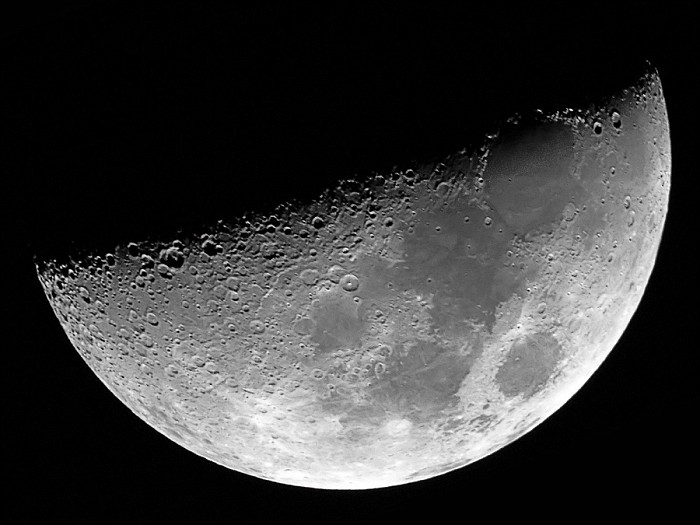
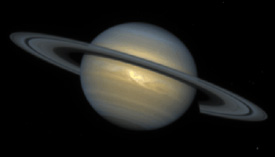
Sevabımıza 23 Şubat 2007’de görüntülediğimiz Satürn
(Zuhal) seyyaresi ve sevgili ay dedemizi
göndermekteyiz ki anlayana nâmütenahi ibretler vardır.
Fakîr-i pûr taksir,
Dr. Timur Sümer
Sevgili Tarsus’zedeler :
iki hafta mukaddem, sevgili Cenap’ımız, Michigan
eyaletinin Fenton sancağındaki fakirhaneyi teşrif
ettiler. Sevgili eşi Lucy ve kerîmesi Defne Meksika’da
olduklarından, Cenap’ımız bu sefer bizi yalnız ziyaret
etti.

Geçmişteki ziyaretlerinden ders çıkardığımızdan, bu
sefer de aynı rezillikleri eder kuşkuyla tedbirler
aldıysak da, sonunda ziyadesiyle taaccüb edip
davranışımızdan hicab ettik.
Tellifonda, “Gelirken size ne getireyim” diye sual
edince, Küba cıgarı getirmesini istedik ki, Küba cıgarı Amerika’da hepten
yasak olduğundan gümrükte
yakalanıp bir güzel derdest edilsin istedik.
Lâkin, Cenap’ımız allem ederekten cıgarları getirmekle
kalmayıp, birer kutu içre hamsi balığı ve de lahmacun
dahi getirerek tüm gümrükçüleri atlatmakla kalmayıp
bizleri de ihyâ etti. Hamsilerden ikisini evimizin
ağuşundaki göle salıverdik ki niyetimiz, garipler çoğalsın , ve
de gelecek yıl kendi hamsimizi kendimiz tutuverelim.


Cumhuriyet bayramı kutlama balosu davetimizi ise
gravat takmak istemediğinden kibarca geri çevirdi.
Cenap’ın bize getirdiği en büyük mutluluk ise SİGARA
İLLETİNİ BIRAKMIŞ OLMASIDIR. Kendisini bu son derece
zorlu uğraşında şuracıkta kutlar hepinizi de kutlamaya
davet ederim.
Kulak çınlamalarınızın nedeni bizim mavralarımız
olduğundan, sakin ola kulak doktoruna gidip paracıklarınızı
heder etmeyesiz.
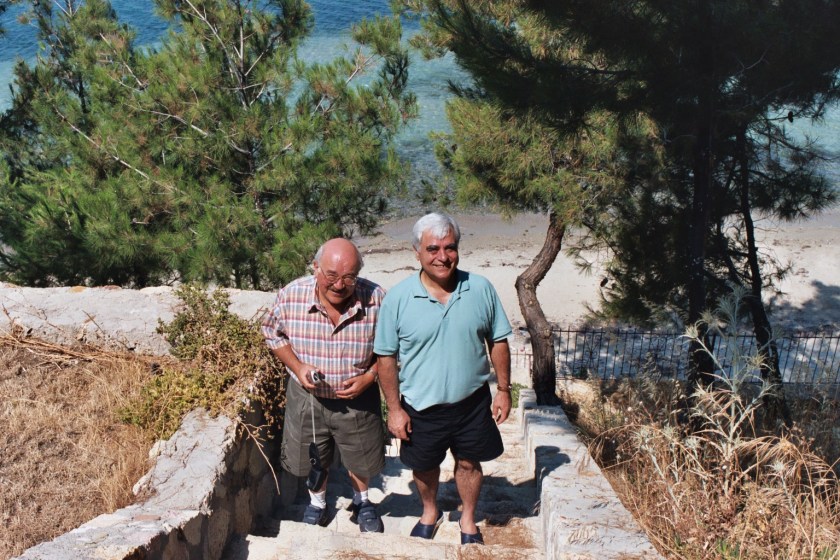
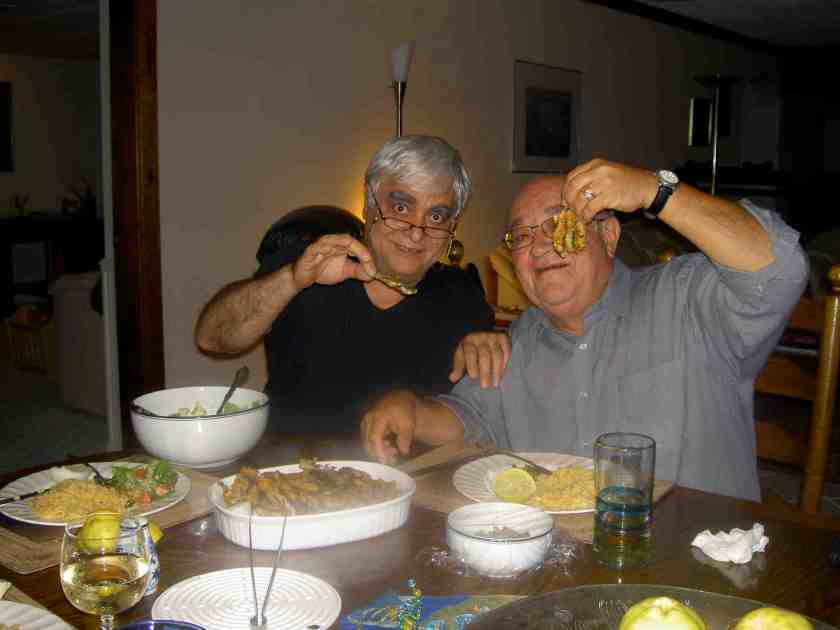
Bu ziyaretin görüntülerini ise ekte göndermekteyiz.
Sırıtaraktan kullanın.
Timur
Sevgili Tarsuszede’ler:
Adı hiç lazım değil, hepinizin bildiği, bu rezil İntik Cenap, Türkiyemiz’e uçarken, mutad üzere, yanına güzel bir hatun oturmakla, bizimki “hapşuu !” diyerekten aniden bir hapşırsın.., hatundur “çok yaşayasın” demesine kalmadan , bizim rezil cebinden koca bir mendil çıkarıp pantalonunun fermuarını indirmesiyle, başlamış, ayıptır söylemesi, çükünü silip kurulamaya.. ki, aradan az bir zaman geçip, bizim rezil ikinci hatta üçüncü defa hapşırıp af buyurun her seferinde maslahatını kurulamasıyla, güzel hanım efendidir, haliyle eğitim görmüş ve de aile terbiyesi almış olduğundan, ağdalı İngilizcesiyle, “affınızı istirham ederim bey efendi hazretleri, tecessus saikiyle sual eylemekteyim. ., zat-ı aliniz hapşırmanız ertesi nedendir acaba behemahal tenasül uzvunuzu kurulamak ihtiyacını hissetmektesiniz ?” anlamına, İngilizce olaraktan, “what the hell you are doing.. you fuckin’ son of a bitch ? I will call the security” diye sual ettikte, bizim rezildir, “Amanın hanımcığım, sen amanı bilir misin. Bendeniz, fevkalade nadir bir sayrılıktan muzdarip olup.., Hüda düşman başına versin, vakta ki hapşırayım, behemahal orgasm haline geçip her bir yanı batırmaktayız” demesiyle, güzel hatundur, yüreği parçalanıp merhamete gelmiş, “vah zavallım, içim parçalandı, ne ilaç kullanmaktasınız bari bu durumda?” diye sual etmesiyle, bizim bi-haya ve rezil İntik eydur; “KARABİBER”.
Hoş kalasınız,
Timur
Sevgili Tarsuszede’ler
İntik Cenap’imiz geçtiğimiz hafta fakirhaneyi bir
teşrif ettiler ki birlikte geçirdiğimiz üç günün
tadına doyamayıp, çınlatmadık kulak bırakmadık.
Sevgili Cenap’ın elinden düşürmediği iğrenç cıgaraları
yüzünden bir eli tümden battal olsa dahi, tek eliyle
evimizde ne kadar bozuk kırık eksik varsa ırgat gibi
çalışıp tümünü de onardı. Üstelik getirdiği pişmaniye,
sucuk, pastırma gibi buralarda az bulunan nemalarıda
sayarsak, bu ziyaret bizce de pek ganimetli olmuştur.
Tez vakitte yeniden gelmesi muradıyla, selametle gitti
gider.
Anlattığı mavralardan birisi ise aynen şöyle olup,
güyasıdır, İntik Toronto otelinin barında bir yosmaya
rastlamış iken, laf lafı açmasına açar da,
kadıncağızın halbuki en önemli uğraşı erkek cinsel
organı değil miymiş? Cenap’imiza tafsilatıyla nasıl
her milletten erkeğin erkekliğini avucuna alıp, enini,
boyunu, başını, sonunu inceleyip, ölçüp fakat asla
biçmeyip bilimsel araştırmalar yaptığını anlatıp
durasıymış. En kalın tarrağın İran’lı, en uzun
tarrağın ise İtalyan erkeklerinde olduğunu eyittikten
sonra, haliyle de, oda numarasını verip ayrılırken,
Cenap’imiza, “adını bağışla yiğidim” diye sual
ettikte, günahı boynuna, İntik de bir güzelcene
eyitmesin de ne etsin ?
“Antonioni Rafsancani”
Kalın sağlıcakla
Timur
Sevgili Tarsus’zedeler ve öteki arkadaşlar:
Yarın olunca, İntik Cenap fakiri ziyarete
geleceğinden, haliyle epeyce tedirgin isek de, nidelim
“eski arkadaştır” deyüp katlanacağız. Yine de İntik’in
son mavrasını sizlerle üleseyim istedim.
Güyadır, İntik olup Kanada’nın Toronto ilindeki bir
içki barına gitmesiyle, az ilerde oturan bir yoşmayı
gözcağızına kestirip, tiz elden otel odasına atmak
muradıyla, garson ile barın en pahalı “Merlot” teşmiye
şarabını hatuna gönderesiymiş. Sırıtaraktan hatunun
tepkisini bekleye dursun, yoşmadır bir kağıt üzre “ha
ben bu şarabi içerimse de ancak, kapu taşrasında bir
Mercedes araban, bankada bir milyon gavur doların ve
de bacak aranda 20 santimlik bir uzantın olmak gerek”
yazıp İntik’imiza yollamasıyla, İntik’tır, günahı
boynuna, o dahi aynı kağıt üzre söylecene yazıp
kadıncağıza gep gerisin yolladığını eyitti.
“Haliyle, kapumuz taşrasında bir adet Ferrarı
Testarosa’miz, hattası bir adet de Mercedes’imiz,
bankada ise Hüda’ya hamd olsun, on milyonumuz
bulunmaktadur. Lakin, bacak aramızdaki uzantıyı
asgarisinden 10 santimetre kestirmeye ise gönlümüz
katiyyenrazı olmadığından, Merlot şarabımız derhal
geri gönderile”
İmza: İntik Cenap.
Dahi mavralarımızı bekleyesuz.
Midye dolması misali sırıtaraktan,
Timur

So there’s good inflation after all. On Monday a team of astronomers reported finding gravitational waves dating back more than 13 billion years. The finding, based on years of observational work from radio telescopes at the South Pole, strongly supports a standard theory in modern cosmology known as “inflation,” which in turn explains the uniformity of the cosmos.
Is this the last word on the subject? No: Mistakes can be made when you are peering at a picture of the universe when it was merely 380,000 years old. Data gathered by the European Space Agency’s Planck satellite offered different cosmic temperature readings. And contrary to what you might have heard from Al Gore, scientific “consensus” is subject to change based on new facts.
Still, this week’s findings are an example of cautious empirical research shoring up elegant scientific theory. Gravitational waves were first predicted by Albert Einstein nearly a century ago as part of his general theory of relativity. “Inflation” itself was the brainchild of physicist Alan Guth. As a young scientist at Stanford, he had, as he wrote to himself in 1979, a “SPECTACULAR REALIZATION” about how the cosmos might have evolved. These days he says he’s surprised that he might live long enough to have his Eureka moment confirmed. Archimedes would have understood.
This week’s discovery is the second time in as many years that a fundamental theory in physics had been validated. In 2012 researchers at the CERN particle collider found the Higgs boson, the elementary particle whose existence was necessary to the so-called standard model of particle physics. The boson is named after British physicist Peter Higgs who, along with Belgium’s François Englert and other physicists, first proposed its existence in the early 1960s. They had to wait nearly 50 years for technology to catch up to their imaginations.
We live in an age when science is supposed to be practical, and too often is political. This week’s findings likely won’t make for a better smartphone or a faster computer chip next year. Nor will they tell us what the temperature will be in a decade or a century. Thank goodness—or God—that there are still pockets of academia that are about the wonder of it all, irrespective of race, class and gender.
This cosmic scoop is also a reminder that our greatest discoveries come from rationality, observation, experiment and, above all, the freedom of inquiry. The task for those of us not peering into the heavens is to sustain a world friendly to those who do.


 Timur Sümer
You must be logged in to post a comment.